When most people picture dolphins, they probably imagine animals leaping through blue ocean water. But deep in the rivers and flooded forests of South America, dolphins have adapted to an entirely different world.
The dolphins of the Amazon are some of the most unusual aquatic mammals on Earth. They live in freshwater rivers, navigate through muddy water, and can move between channels and flooded forests during the wet season. Their lives are closely connected to the changing water levels of the Amazon basin.
The best-known of these animals is the Amazon river dolphin, often called the pink river dolphin or boto. However, other river dolphins occur in the wider Amazon and Orinoco regions as well.
From their unusual pink coloring to their flexible necks and remarkable ability to navigate flooded forests, Amazonian dolphins have developed a fascinating set of adaptations. This guide explores where they live, what they eat, how they communicate, how they reproduce, and the challenges they face in the wild.
Key Takeaways
- Amazon river dolphins are freshwater mammals adapted to life in the rivers, lakes, and flooded forests of the Amazon basin.
- Their pink coloration, flexible necks, and broad flippers are among their most distinctive physical adaptations.
- They rely heavily on echolocation to navigate and find food in the often murky waters of the Amazon.
- Protecting rivers, wetlands, fish populations, and surrounding rainforest habitats is essential for the long-term survival of these dolphins.
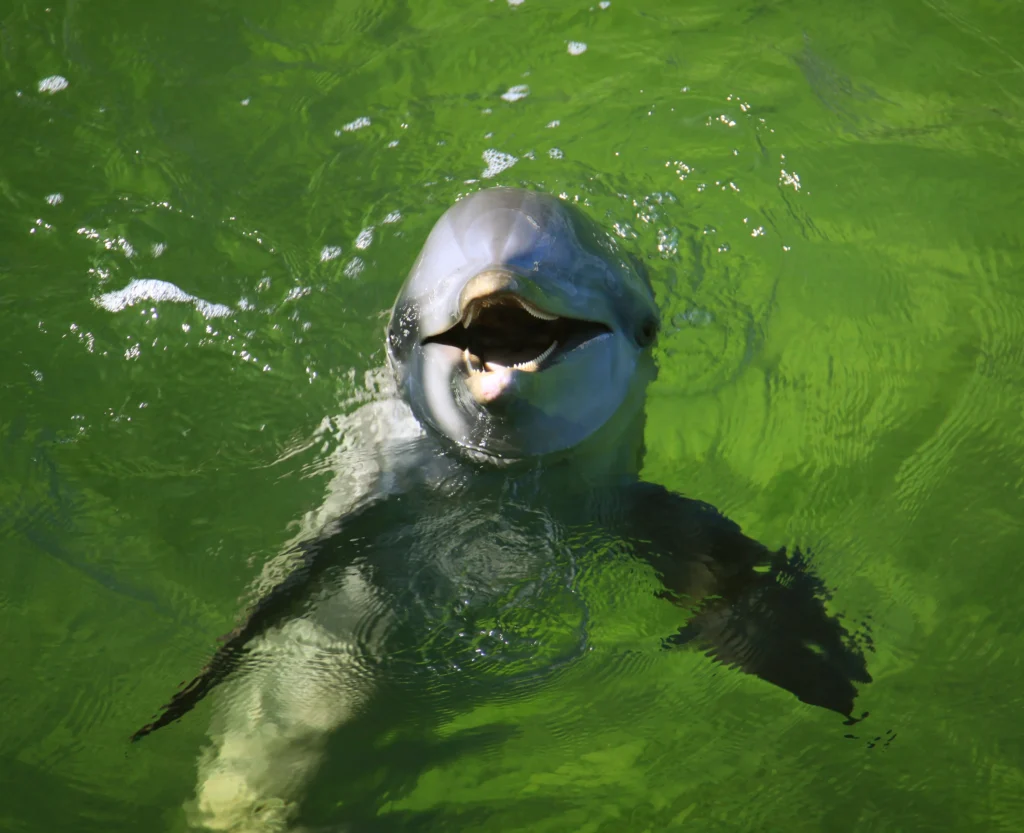
What Are the Dolphins of the Amazon?
The term “dolphins of the Amazon” commonly refers to freshwater dolphins found in the Amazon and surrounding river systems.
The most famous is the Amazon river dolphin, scientifically known as Inia geoffrensis. It is also commonly known as the boto or pink river dolphin.
Unlike most dolphins, which are associated with oceans and coastal waters, Amazon river dolphins spend their lives in freshwater environments.
They are found throughout much of the Amazon basin, where rivers, tributaries, lakes, and seasonally flooded forests provide habitat.
Another closely related freshwater dolphin, the Bolivian river dolphin, is recognized as a distinct population or species by some authorities. It occurs primarily in Bolivia’s upper Madeira basin.
There is also the Araguaian river dolphin, which lives in the Araguaia-Tocantins river system in Brazil.
The classification of these dolphins has been the subject of scientific research and debate, particularly concerning how closely related different populations are.
Why Are Amazon River Dolphins Pink?
The pink color is probably the feature most people associate with Amazon river dolphins.
However, not every individual is bright pink.
Young Amazon river dolphins are generally darker, often appearing grayish. As they mature, some individuals develop increasingly pink coloration.
Several factors can influence their appearance, including age, sex, skin condition, and physical activity.
Adult males are often more strongly pink than females, and older males can develop particularly vivid coloring.
The skin contains a rich network of blood vessels close to the surface, which may contribute to the pink appearance.
Scarring can also affect coloration. Adult dolphins, especially males, can accumulate scratches and scars from interactions with other dolphins or their environment. These marks can contribute to the distinctive appearance of mature animals.
So, despite their nickname, Amazon river dolphins are not simply born bright pink.
Their coloration changes throughout their lives.
Where Do Amazon River Dolphins Live?
Amazon river dolphins occupy a huge freshwater environment.
Their range includes major rivers and tributaries throughout parts of Brazil, Peru, Colombia, Bolivia, and other areas of the Amazon and Orinoco basins.
They can be found in:
- Large rivers
- Smaller tributaries
- Floodplain lakes
- Channels
- Confluences
- Seasonally flooded forests
- Areas near river islands
One of their most impressive abilities is their capacity to use flooded forests.
During the rainy season, water levels rise dramatically across parts of the Amazon basin. Rivers can spill over into surrounding forests, creating temporary waterways beneath the trees.
Amazon river dolphins can enter these flooded areas to search for food.
When the water recedes, they return to the main rivers and permanent channels.
This seasonal expansion and contraction of habitat plays an important role in their lives.
Can Amazon River Dolphins Live in the Ocean?
Amazon river dolphins are primarily freshwater animals.
They are not adapted to living permanently in marine environments in the same way as oceanic dolphins.
However, some populations can occur in areas influenced by tidal water, particularly around river mouths and estuarine environments.
Their ability to tolerate different water conditions is one of the reasons they can occupy such a broad range of habitats.
Still, the Amazon river dolphin’s lifestyle is fundamentally linked to freshwater rivers and floodplain ecosystems.
What Do Amazon River Dolphins Eat?
Amazon river dolphins are opportunistic predators.
Their diet can include a wide variety of aquatic animals, with fish making up an important part of their diet.
Depending on the habitat, they may also consume crustaceans and other aquatic prey.
Their diet can change according to the season.
During periods of high water, fish gain access to flooded forests and other newly available habitats. Dolphins can follow them into these areas, taking advantage of the seasonal abundance.
The ability to feed in different environments gives Amazon river dolphins an advantage in a river system that changes dramatically throughout the year.
They are not restricted to one particular type of fish or feeding location.
How Do Amazon River Dolphins Find Food?
Finding prey in the Amazon can be challenging.
The water is often cloudy and filled with suspended sediment, making it difficult to rely on vision alone.
This is where echolocation becomes extremely important.
Amazon river dolphins produce high-frequency sounds and listen for the returning echoes. These echoes provide information about objects in their surroundings.
Echolocation can help them locate prey and navigate through murky water.
Their ability to maneuver through complex underwater environments is especially useful in flooded forests, where submerged tree trunks, branches, roots, and other obstacles can make movement difficult.
Why Are Amazon River Dolphins So Flexible?
One of the most unusual features of the Amazon river dolphin is its neck.
Unlike oceanic dolphins, which generally have relatively rigid necks, Amazon river dolphins have much more flexible cervical vertebrae.
This flexibility allows them to move their heads from side to side.
That may not sound particularly important until you consider their environment.
Imagine trying to find fish among submerged trees, roots, branches, and narrow channels. A dolphin with a flexible neck can maneuver its head around obstacles and investigate tight spaces more effectively.
Their flippers are also relatively broad, further helping them maneuver in complex freshwater habitats.
These adaptations make the Amazon river dolphin particularly well suited to flooded forests.
Can Amazon River Dolphins See?
Yes, but vision is not their only important sense.
Their eyes are relatively small compared with those of many marine dolphins, and the conditions in their habitat can make vision difficult.
The water in many Amazonian rivers can be extremely murky.
Instead of depending entirely on sight, these dolphins use echolocation to understand their surroundings.
They also have sensitive whisker-like structures around the snout when young, although these structures become less obvious as they mature.
Their sensory abilities allow them to function in an environment where visibility can change dramatically depending on water conditions.
Are Amazon River Dolphins Intelligent?
Like other dolphins, Amazon river dolphins have relatively large brains and display complex behaviors.
They can learn, remember, communicate, and adapt their behavior to their surroundings.
Researchers have observed social interactions, coordinated movements, playful behavior, and different feeding strategies.
However, intelligence is difficult to measure across different species.
It is more useful to say that Amazon river dolphins display a range of sophisticated behaviors that allow them to survive in an unusually complex environment.
Their ability to navigate changing rivers and flooded forests is itself a remarkable example of behavioral adaptability.
Are Amazon River Dolphins Social?
Amazon river dolphins are not known for forming enormous, tightly organized groups like some oceanic dolphin species.
They are often seen alone or in relatively small groups.
However, this does not mean they are antisocial.
Individuals can interact with one another, particularly around feeding areas, breeding, or other social situations.
They may also gather temporarily where food is abundant.
Their social structure appears to be more flexible than the large permanent groups seen in certain marine dolphin species.
How Do Amazon River Dolphins Communicate?
Communication among Amazon river dolphins is still being studied.
They produce a variety of sounds and use echolocation clicks to navigate and locate prey.
Their acoustic environment is complicated because rivers contain many natural sources of noise, including flowing water, other animals, boats, and human activity.
Researchers continue to investigate how Amazon river dolphins use sound for social communication and navigation.
Their underwater acoustic world is probably much richer than what humans can perceive from the surface.
How Do Amazon River Dolphins Reproduce?
Amazon river dolphins reproduce sexually, with females giving birth to live young.
Pregnancy lasts for roughly a year, although estimates can vary.
Females generally give birth to a single calf.
A newborn calf is considerably smaller than its mother and remains dependent on her while it develops.
The mother provides milk and protects the young dolphin as it learns how to navigate and find food.
Because Amazon river dolphins live in environments where water levels change dramatically, raising a calf requires navigating a complex and constantly changing habitat.
What Do Baby Amazon River Dolphins Look Like?
Baby Amazon river dolphins are generally darker than adults.
They do not begin life with the bright pink appearance that some older individuals eventually develop.
The calf stays close to its mother, learning how to swim, breathe, locate food, and navigate its environment.
As it grows, its body changes and its coloration can gradually become lighter.
Young dolphins must eventually learn how to exploit the different habitats available during seasonal changes in the river.
This includes understanding where fish are found and how to navigate channels and flooded areas safely.
How Long Do Amazon River Dolphins Live?
Their exact lifespan in the wild is not known with the same certainty as that of some better-studied marine mammals.
Estimating the age of wild river dolphins can be difficult because researchers cannot observe an individual throughout its entire life.
Some individuals are known to survive for decades, but threats from human activity and environmental changes can affect survival.
Long-term studies are important for understanding population structure, reproduction, mortality, and lifespan.
Do Amazon River Dolphins Have Predators?
Adult Amazon river dolphins are large aquatic predators themselves, so they have relatively few natural predators.
Young calves are more vulnerable.
Large aquatic predators, such as caimans and large fish, may pose risks in certain situations.
However, human activity is a much greater concern for many river dolphin populations.
Entanglement in fishing gear, habitat degradation, pollution, accidental capture, and direct killing can all affect populations.
Why Are Amazon River Dolphins Important?
Amazon river dolphins are an important part of freshwater ecosystems.
As predators, they interact with fish populations and participate in the broader food web.
Their presence can also provide information about the health of river environments.
Because they depend on functioning aquatic ecosystems, declines in dolphin populations can indicate broader environmental problems.
Protecting river dolphins therefore involves more than protecting individual animals.
It means protecting the rivers, floodplains, wetlands, fish populations, and surrounding habitats they depend on.
What Threats Do Amazon River Dolphins Face?
Amazon river dolphins face several human-related threats.
Fishing
Fishing activity can create problems when dolphins become accidentally trapped or entangled in nets and other fishing equipment.
Competition for fish can also become an issue when fishing pressure is high.
Pollution
Rivers can carry agricultural chemicals, industrial pollutants, sewage, plastics, and other contaminants.
Because dolphins occupy relatively high positions in the aquatic food web, pollutants can accumulate in their bodies over time.
Dams
Hydroelectric development can alter river flow, fragment habitats, and change how fish move through river systems.
For an animal that depends on connected waterways, changes to river connectivity can have serious consequences.
Mining
Mining activities can introduce sediment and pollutants into rivers.
In parts of the Amazon, concerns about mercury contamination associated with gold mining are particularly significant.
Mercury can enter aquatic food webs and eventually reach predators such as dolphins.
Boat Traffic
Increasing boat activity can disturb dolphins and create the possibility of collisions.
Engine noise may also interfere with the acoustic environment they rely upon.
Are Amazon River Dolphins Endangered?
The conservation status of Amazon river dolphins is an important subject of ongoing research.
Different populations can face different levels of risk, and scientific classifications can change as researchers gather more information.
The International Union for Conservation of Nature (IUCN) has assessed Amazon river dolphins as Endangered, reflecting concerns about population declines and continuing threats.
Conservation is complicated because the animals inhabit enormous river systems that cross political boundaries.
Protecting them requires cooperation between governments, scientists, fishing communities, Indigenous communities, conservation organizations, and local residents.
How Can People Help Protect Amazon River Dolphins?
Protecting the dolphins begins with protecting the ecosystems they depend on.
Several actions can help:
- Reduce pollution entering rivers.
- Support sustainable fishing practices.
- Protect floodplain forests and wetlands.
- Improve monitoring of dolphin populations.
- Reduce harmful interactions with fishing gear.
- Limit disturbance around important dolphin habitats.
- Improve regulation of mining and other activities that pollute waterways.
- Protect natural river connectivity where possible.
Local communities are particularly important to conservation efforts because they live alongside these animals and understand the river environment in ways that outside researchers may not.
Can You See Amazon River Dolphins in the Wild?
Yes, but seeing one is never guaranteed.
Travelers exploring parts of the Amazon basin may encounter river dolphins in rivers, lakes, tributaries, or flooded forests.
The best approach is to observe them responsibly.
Do not chase dolphins with boats or attempt to touch them.
Keep a reasonable distance and allow the animals to decide whether they want to approach.
Wildlife tourism can provide economic benefits to local communities, but poorly managed encounters can cause unnecessary stress to animals.
A quiet observation from a respectful distance is usually far more rewarding than trying to force a close encounter.
Why Are Amazon River Dolphins Different From Ocean Dolphins?
At first glance, both may look like dolphins, but their environments have shaped them in very different ways.
Amazon river dolphins have:
- More flexible necks
- Broader flippers
- Different body proportions
- Specialized adaptations for shallow, complex water
- Strong reliance on echolocation in murky rivers
- The ability to navigate flooded forests
Ocean dolphins generally live in open water where there are fewer physical obstacles.
Amazon river dolphins, on the other hand, may have to maneuver through trees, roots, channels, and shallow areas.
Their unusual appearance is therefore closely connected to the environment in which they evolved.
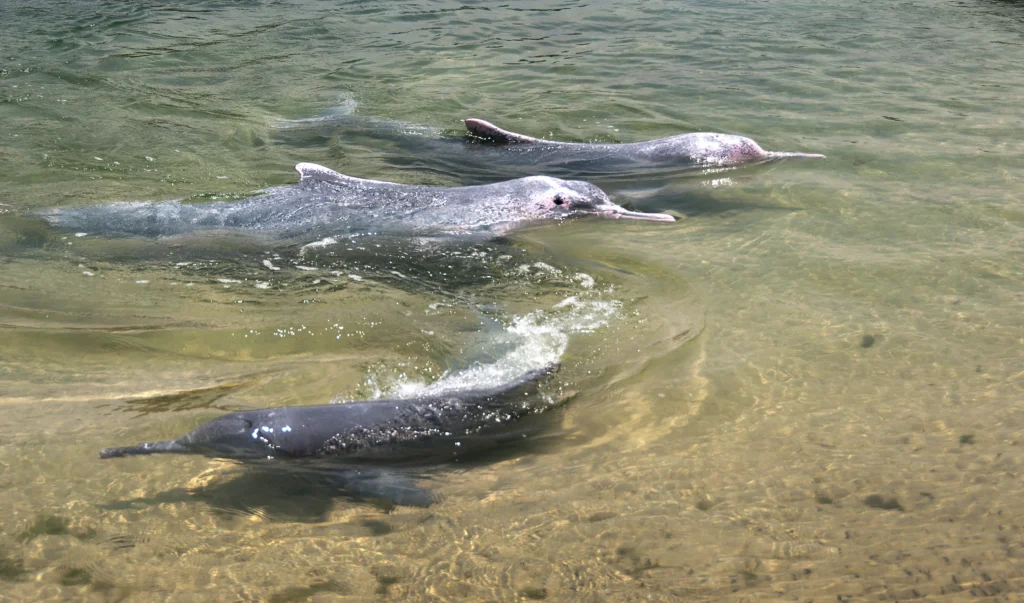
Fascinating Facts About Amazon Dolphins
Here are a few facts that make these dolphins particularly interesting.
- They can swim through flooded forests. When rivers rise, dolphins can move among submerged trees in areas that would be inaccessible during the dry season.
- Their necks are unusually flexible. This helps them maneuver around obstacles.
- Pink coloration develops with age. Not every individual is bright pink.
- They use echolocation. This helps them find prey and navigate murky water.
- They can live in very different types of freshwater habitat. Rivers, lakes, channels, and flooded forests can all become part of their range.
- Their environment changes dramatically throughout the year. Seasonal flooding can completely transform the landscape available to them.
- They are important freshwater predators. Their feeding behavior connects them to the wider river ecosystem.
FAQs About Dolphins of The Amazon
How do Amazon river dolphins adapt to seasonal flooding?
Amazon river dolphins can move between main rivers, tributaries, lakes, and flooded forests as water levels rise and fall. Their flexible bodies and necks help them maneuver through areas filled with submerged vegetation and trees.
Are Amazon river dolphins found in Ecuador?
Yes. Amazon river dolphins can be found in parts of the Ecuadorian Amazon, particularly within river systems connected to the wider Amazon basin. Ecuador’s rainforest waterways provide important habitat for these freshwater mammals.
What is the difference between a boto and an Amazon river dolphin?
“Boto” is a common name used for the Amazon river dolphin. Both names generally refer to the same freshwater dolphin, Inia geoffrensis, although local names can vary across the Amazon region.
Can Amazon river dolphins survive in polluted rivers?
Pollution can make survival more difficult for Amazon river dolphins. Contaminants entering rivers can accumulate in aquatic food webs and may affect dolphins directly or indirectly by reducing the health of their habitat and prey.
How do Amazon river dolphins navigate through flooded forests?
They use echolocation along with other senses to navigate through murky water. Their flexible necks and broad flippers also help them turn and maneuver around submerged trees, roots, and other obstacles.
Do Amazon river dolphins interact with people?
Amazon river dolphins may encounter people in areas where communities live along rivers. However, their behavior toward humans varies, and wild dolphins should always be observed without attempting to touch, feed, or chase them.
How deep can an Amazon river dolphin dive?
There is limited information about the maximum diving depth of Amazon river dolphins in the wild. Unlike many oceanic dolphins, they commonly live in relatively shallow freshwater environments, where their ability to maneuver is more important than making extremely deep dives.
What sounds do Amazon river dolphins make?
They produce clicks and other sounds that help them communicate and navigate their environment. Their echolocation clicks are particularly important because Amazon rivers can be cloudy and difficult to see through.
How do scientists track Amazon river dolphin populations?
Researchers use methods such as boat surveys, photographic identification, acoustic monitoring, and long-term population studies. These approaches help scientists understand where dolphins occur and how their populations change over time.
Why are freshwater dolphins important to the Amazon ecosystem?
Amazon river dolphins are predators within freshwater food webs and are closely connected to the health of river ecosystems. Protecting their habitat also helps conserve the rivers, fish, wetlands, and other wildlife that share the same environment.
Conclusion
The dolphins of the Amazon are a remarkable example of how wildlife can adapt to an environment that changes throughout the year. Instead of living in open oceans, these dolphins navigate rivers, tributaries, floodplain lakes, and even forests that become submerged during the rainy season.
Their flexible necks, specialized feeding abilities, echolocation, and changing coloration all reflect the unique demands of life in the waterways of South America.
For anyone planning to experience the Ecuadorian Amazon, seeing this incredible ecosystem in person can be an unforgettable experience. From wildlife and flooded forests to winding waterways and remote rainforest landscapes, the Amazon offers countless opportunities to connect with nature.
For an amazing Ecuadorian Amazon experience, consider planning your stay at La Selva Eco-Lodge & Retreat. Surrounded by the remarkable biodiversity of the Amazon rainforest, it can be a memorable base for exploring the region and experiencing its wildlife and natural beauty.
If you are planning to visit the Amazon, La Selva Eco-Lodge & Retreat is a wonderful place to consider for your Ecuadorian Amazon adventure.