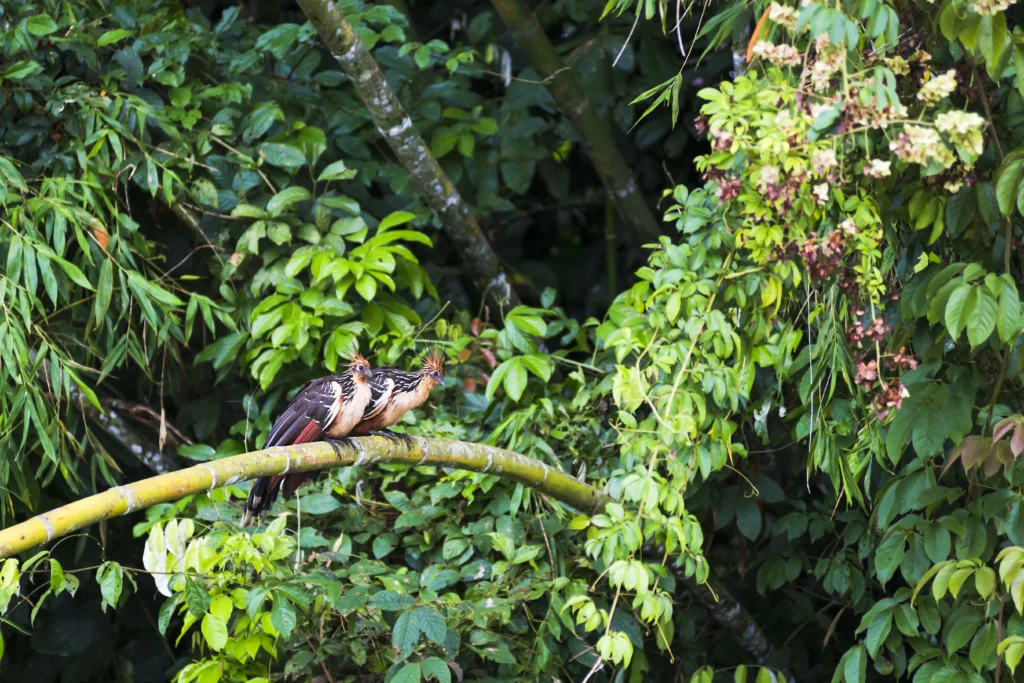
The Amazon rainforest is home to thousands of bird species, but some are much easier to recognize than others. The Hoatzin is one of the birds that visitors often remember after seeing it for the first time.
With a messy crest, blue skin around its eyes, a long tail, and a somewhat unusual smell, the Hoatzin does not look like a typical rainforest bird. It also has some unusual habits. Young Hoatzins have claws on their wings, and the birds mainly eat leaves instead of hunting insects or small animals.
The Hoatzin is found around rivers, lakes, flooded forests, and wetlands across parts of the Amazon and other areas of tropical South America. Because it often stays close to water and feeds on plants growing near wetlands, it can be an interesting bird to look for during an Amazon rainforest trip.
Here is a complete guide to understanding the Hoatzin, including what it looks like, where it lives, what it eats, how it behaves, and where you may have a chance to see one.
Key Takeaways
- A truly unusual rainforest bird: The Hoatzin stands out for its large crest, blue face, long tail, and distinctive appearance.
- A bird that lives on leaves: Unlike most birds, the Hoatzin feeds mainly on leaves and uses a special digestive system to process them.
- Baby Hoatzins have a surprising survival skill: Young chicks have claws on their wings and can climb through branches and swim when they need to escape danger.
- Look near Amazon waterways: Hoatzins are commonly associated with rivers, lakes, lagoons, wetlands, and flooded forests where leafy plants grow.
- A memorable bird to spot in the wild: A quiet boat ride with a local naturalist guide can be one of the best ways to look for Hoatzins in their natural habitat.
What Is a Hoatzin?
The Hoatzin is a tropical bird with the scientific name Opisthocomus hoazin. It is sometimes called the stinkbird because of the unusual odor that can come from its digestive system.
The bird is native to tropical South America. It is especially associated with areas of dense vegetation near water.
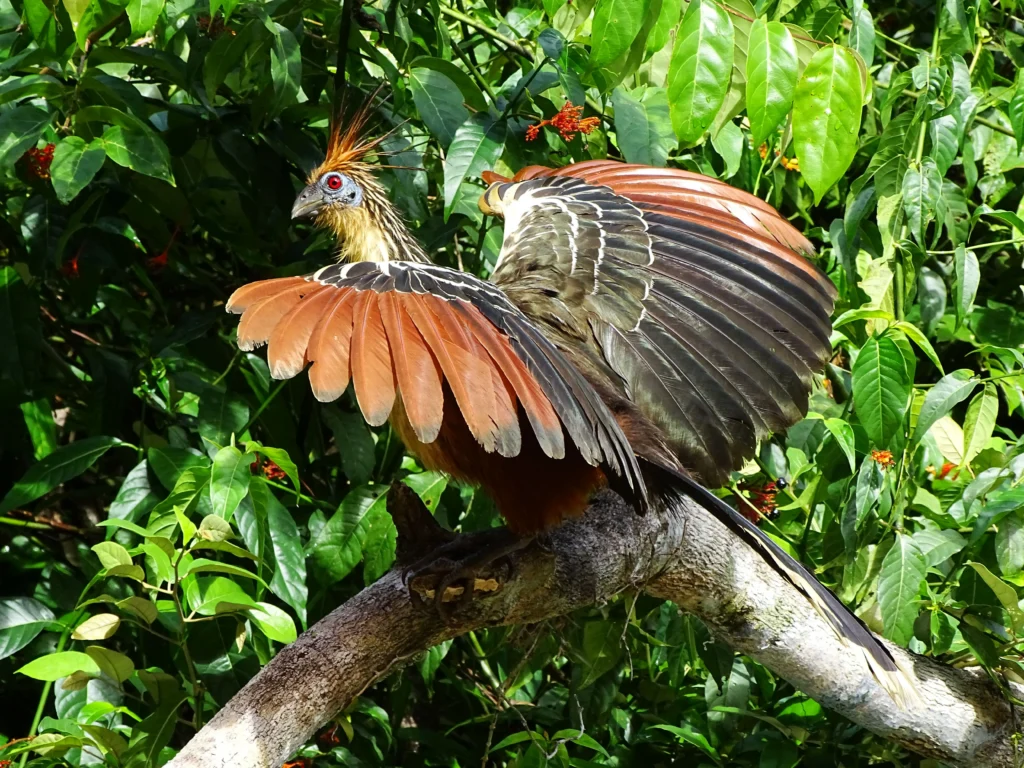
The Hoatzin has a distinctive appearance. Adults have a brown and reddish body, a long tail, a large crest of feathers on the head, and bright blue skin around the face. Its wings are broad, and its body has a somewhat bulky appearance.
One reason the Hoatzin attracts so much attention is that it does not fit neatly into the appearance of many familiar bird groups. Scientists have spent a long time studying its evolutionary relationships.
For travelers, however, the easiest thing to remember is its appearance. If you see a large bird with a spiky crest sitting quietly in vegetation beside an Amazonian waterway, there is a good chance you are looking at a Hoatzin.
Where Does the Hoatzin Live?
Hoatzins are closely associated with tropical wetlands and waterways.
They can be found around rivers, lakes, oxbow lakes, flooded forests, swamps, and other areas where vegetation grows close to water. The species occurs in several countries in tropical South America.
In the Amazon region, Hoatzins can be found in places with plenty of leafy vegetation. They are particularly associated with plants growing along the edges of waterways.
This makes them an interesting species to look for during river trips through the rainforest.
Unlike some rainforest birds that spend much of their time high in the canopy, Hoatzins are often seen in lower vegetation near water. A boat moving slowly along a river or lagoon can provide a good opportunity to spot them.
What Does a Hoatzin Look Like?
The Hoatzin is not difficult to identify once you know its main features.
An adult has a large feathered crest on its head. The crest can look untidy or spiky, which gives the bird a very different appearance from many other Amazon birds.
Its body is mainly brown and reddish, while the underside of the wings can show warmer colors. The tail is long and dark.
Another noticeable feature is the blue skin around the face and eyes. The combination of blue facial skin, red eyes, brown feathers, and a large crest makes the Hoatzin quite easy to recognize.
The bird also has a strong-looking bill that helps it handle the leaves that make up much of its diet.
Why Is the Hoatzin Called the Stinkbird?
One of the Hoatzin’s most famous features is its unusual smell.
The nickname stinkbird comes from the odor associated with its digestive system. Hoatzins have a specialized digestive system that allows them to break down large amounts of plant material.
Their digestive process is somewhat similar to fermentation. Microorganisms in the digestive system help break down leaves before the nutrients are absorbed.
This process can produce an odor that some people compare to the smell of manure or fermented vegetation.
The smell is not the main reason the Hoatzin is interesting, but it is certainly one of the easiest facts to remember about the species.
What Does the Hoatzin Eat?
The Hoatzin is unusual because it is primarily a leaf-eating bird.
Its diet consists largely of leaves, although it can also eat flowers and other plant material. It spends much of its time sitting in vegetation and feeding rather than actively searching for insects or chasing prey.
Eating leaves presents a challenge because leaves contain a lot of fiber and are not always easy for animals to digest.
The Hoatzin has adapted to this diet with its specialized digestive system. Fermentation helps break down plant material before the bird absorbs nutrients.
Because leaves make up such an important part of its diet, Hoatzins often stay around areas where suitable plants are readily available.
How Does the Hoatzin Digest Leaves?
The digestive system of the Hoatzin is one of the most interesting things about the bird.
Unlike many birds, the Hoatzin uses a fermentation process in the front part of its digestive system to help break down plant material.
Microorganisms help digest the leaves. This is somewhat comparable to the way fermentation helps certain mammals process tough plant material.
This adaptation allows the Hoatzin to survive on a diet that would be difficult for many other birds.
There is a trade-off, though. The fermentation process requires space, so the Hoatzin has a relatively large digestive system. This contributes to the bird’s bulky body shape.
It also means that the Hoatzin is not particularly agile compared with many other rainforest birds.
Baby Hoatzins Are Very Different
Young Hoatzins have one of the strangest features found among modern birds.
Chicks have two claws on each wing.
These claws help young Hoatzins move through branches and vegetation. If a chick falls from its nest into the water, it can use its wings and claws to climb back toward the vegetation.
As the bird grows, the wing claws become less important and eventually disappear or become reduced.
The behavior of young Hoatzins is especially interesting because they can swim when necessary. They may enter the water to escape a predator and later climb back into the vegetation.
This gives young Hoatzins a useful way to escape danger while they are still too young to fly well.
How Do Hoatzins Behave?
Hoatzins are often seen sitting quietly on branches above or near water.
They are not known for constantly flying from one place to another. Instead, they spend much of their time feeding, resting, and moving through vegetation.
They can live in groups, and several birds may be seen together in the same area.
When disturbed, a Hoatzin may move through nearby vegetation or fly a short distance to another branch. Its flight can look somewhat awkward compared with birds that are highly adapted for fast and efficient movement.
This is partly related to its heavy digestive system and the way its body is built.
How Do Hoatzins Build Their Nests?
Hoatzins usually build their nests in vegetation close to water.
The nest is made from sticks and plant material and is generally placed above the water or close to a waterway.
Being near water can be useful because young birds can enter the water if they feel threatened.
Several Hoatzins may nest in the same general area, creating small breeding groups along rivers and lagoons.
Parents take care of their chicks and provide protection while the young birds develop.
The ability of young Hoatzins to swim and climb is particularly useful during this vulnerable stage of life.
Where Can You See Hoatzins in the Amazon?
The best places to look for Hoatzins are usually wetlands, river edges, lakes, and flooded forest areas.
They are often easier to spot from a boat than from a forest trail because many of their preferred habitats are located along waterways.
Amazon rainforest destinations with river and lagoon excursions can provide opportunities to see them.
In Ecuador, for example, Hoatzins can be found in parts of the Amazon region around waterways and flooded forest habitats. Similar habitats across Peru, Brazil, Colombia, Bolivia, Venezuela, and the Guianas can also support the species.
If you are staying at an Amazon rainforest lodge, ask your naturalist guide about recent Hoatzin sightings. Local guides often know which rivers, lagoons, and vegetation areas are currently productive for birdwatching.
When Is the Best Time to See a Hoatzin?
Hoatzins can be encountered throughout the year in areas where they live.
However, seeing wildlife in the Amazon is never guaranteed. Rain, water levels, vegetation, and animal behavior can all affect what you see during a particular excursion.
Early morning is often a good time for general rainforest birdwatching because many birds are active around this period.
A quiet boat ride along a river or lagoon can also be helpful. Moving slowly gives you more time to look at vegetation along the banks.
A pair of binoculars can make a major difference because Hoatzins may sit some distance from the boat.
Why Is the Hoatzin Important to the Amazon Ecosystem?
The Hoatzin is part of the complex food web of Amazon wetlands.
By feeding on leaves and other vegetation, it plays a role in the movement of plant material through the ecosystem. It also provides food for predators.
More importantly, the Hoatzin is closely connected to healthy wetland habitats. Its presence reflects the availability of suitable vegetation and the type of environment it needs to survive.
Protecting rivers, flooded forests, wetlands, and other Amazon habitats therefore helps protect the Hoatzin along with countless other species.
Is the Hoatzin Endangered?
The Hoatzin is currently classified as Least Concern on the IUCN Red List.
That does not mean the bird is free from environmental pressures. Like many Amazon species, it depends on natural habitats that can be affected by deforestation, changes in land use, and degradation of wetlands and waterways.
Protecting large areas of rainforest and maintaining healthy river systems remain important for the long-term survival of the species.
Interesting Facts About the Hoatzin
The Hoatzin has several characteristics that make it one of the most unusual birds in South America.
- It is mainly a leaf-eating bird.
- It has a large digestive system adapted for fermentation.
- It is sometimes called the stinkbird because of its odor.
- Young chicks have claws on their wings.
- Young birds can swim when they need to escape danger.
- Adults have a large crest and blue skin around their faces.
- They are strongly associated with wetlands and waterways.
- They are often easier to observe from boats.
- They are found in tropical parts of South America.
- Their evolutionary relationships have been the subject of scientific research.
Tips for Seeing a Hoatzin in the Wild
If seeing a Hoatzin is part of your Amazon trip, a few simple things can improve your chances.
First, spend time around rivers and lagoons. These are some of the bird’s preferred habitats.
Second, bring binoculars. A Hoatzin may be sitting quietly in vegetation where it is difficult to see with the naked eye.
Third, listen to your guide. Local naturalist guides often recognize the bird’s calls and know the places where groups have recently been observed.
Finally, be patient. Wildlife watching is not about seeing every animal immediately. A slow boat ride through a quiet Amazon waterway can reveal birds and other wildlife that you might miss if you move too quickly.
FAQs About the Hoatzin
How big does a Hoatzin get?
An adult Hoatzin is roughly the size of a large chicken, with a body length of around 60 to 70 cm including its long tail.
How much does a Hoatzin weigh?
Most adult Hoatzins weigh around 600 to 800 grams, although weight can vary between individuals.
How long does a Hoatzin live?
The exact lifespan of wild Hoatzins is not well documented, so there is no reliable average lifespan for the species.
Do Hoatzins migrate?
No. Hoatzins are generally resident birds and do not make long seasonal migrations.
Do Hoatzins have predators?
Yes. Eggs and young Hoatzins can be vulnerable to predators such as snakes, monkeys, and birds of prey.
How many eggs does a Hoatzin lay?
A female commonly lays between two and three eggs in a breeding attempt, although clutch size can vary.
How long does it take for Hoatzin eggs to hatch?
Hoatzin eggs generally take around one month to hatch, with both parents helping to care for the nest and young.
What sound does a Hoatzin make?
Hoatzins can produce a range of rough calls, including grunts, croaks, and hoarse sounds. Their calls can help groups communicate with each other.
Are Hoatzins active during the day or night?
Hoatzins are primarily daytime birds. They spend daylight hours feeding, resting, and moving around vegetation near water.
Are Hoatzins found outside South America?
No. Hoatzins are naturally found only in tropical South America, mainly in countries within and around the Amazon Basin and the Guiana region.
Conclusion
The Hoatzin is one of the Amazon rainforest’s most unusual birds. Its large crest, blue face, leaf-based diet, strange digestive system, and clawed young make it unlike many other birds found in the rainforest.
It is also a good example of how animals adapt to their surroundings. Instead of relying on a typical bird diet, the Hoatzin has developed a specialized way of processing leaves. Young birds have their own unusual survival strategy, using wing claws and swimming ability to move through their watery environment.
For travelers exploring the Amazon, spotting a Hoatzin can be a memorable experience. Look along quiet rivers, lagoons, and flooded forest areas, especially where leafy vegetation grows close to the water. With a little patience and a good guide, you may see this remarkable bird resting among the branches and discover one of the Amazon’s most distinctive species.