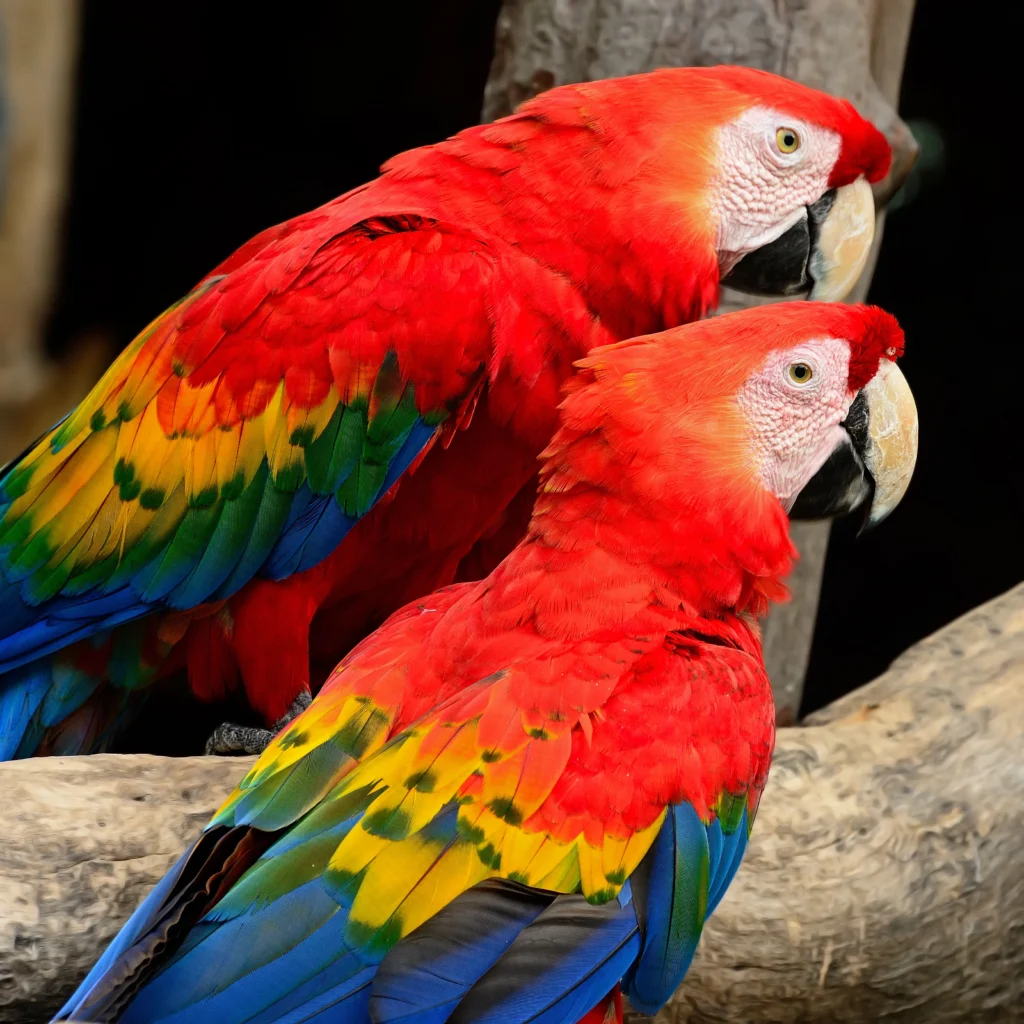
The Amazon rainforest is home to some of the most colorful and fascinating birds on Earth. Among them, macaws stand out for their bright feathers, powerful curved beaks, long tails, and impressive intelligence. Their loud calls can often be heard echoing through the forest, while their vibrant colors make them easy to recognize when they fly above the rainforest canopy.
Macaws are large parrots belonging to the family Psittacidae. Several species live in the Amazon Basin and surrounding regions of South America. They inhabit tropical forests, riverbanks, flooded forests, and areas with clay-rich soil. Their diet includes fruits, seeds, nuts, and other plant materials. Some species also visit natural clay licks, where they consume mineral-rich soil.
Beyond their beauty, macaws play an important role in the Amazon ecosystem. They help disperse seeds, contribute to forest regeneration, and form part of the rainforest’s complex food web. However, habitat destruction, illegal wildlife trade, hunting, and other human activities threaten several macaw populations.
This guide explores the different macaws of the Amazon, where they live, what they eat, how they behave, and why protecting them is essential for the future of the rainforest.
Key Takeaways
- Macaws are large, colorful parrots found throughout tropical Central and South America.
- Several species, including the scarlet, blue-and-yellow, and red-and-green macaws, inhabit the Amazon region.
- They eat fruits, seeds, nuts, berries, and other plant materials.
- Macaws have strong curved beaks that help them crack hard nuts and seeds.
- Many macaws form long-term pair bonds and nest in tree cavities.
- Natural clay licks provide important feeding sites for several Amazonian macaw species.
- Habitat loss and illegal wildlife trafficking are major conservation concerns.
- Macaws contribute to rainforest ecosystems through their feeding and seed-dispersal activities.
What Are Macaws?
Macaws are large members of the parrot family, known for their colorful feathers, strong beaks, long tails, and high intelligence. They are native to the tropical regions of Central and South America, including the Amazon rainforest.
They belong to several genera within the parrot family, including Ara, Anodorhynchus, and Primolius. Not every macaw species lives in the Amazon, but the rainforest supports several important species.
Macaws are among the largest parrots in the world. Depending on the species, they can measure approximately 30 to 100 centimeters from head to tail. Their long tails make up a significant part of their total body length.
Their feet are adapted for climbing and holding food. Like other parrots, macaws have two toes pointing forward and two pointing backward. This arrangement helps them grip branches, climb tree trunks, and handle food.
Their strong beaks are particularly useful for opening hard-shelled nuts and seeds. They also use their feet to hold food while eating.
Macaws are social birds. Some travel in pairs, while others gather in larger flocks. Their loud calls help them communicate, maintain contact, and warn other birds about potential threats.
Where Do Macaws Live in the Amazon?
The Amazon rainforest covers a vast area across several South American countries, including Brazil, Peru, Colombia, Ecuador, Bolivia, and parts of Venezuela and other neighboring countries.
Macaws live in different parts of this region, depending on their species and habitat requirements.
They are commonly associated with:
- Tropical lowland rainforests
- Riverbanks and forest edges
- Flooded forests
- Palm swamps
- Woodland areas
- Open forest clearings
- Areas with natural clay deposits
Many macaws spend time high in the forest canopy, where they find food and shelter. Their strong flight abilities allow them to travel between feeding areas, nesting locations, and clay licks.
Some species prefer dense rainforest, while others can also be found in more open habitats with scattered trees and palm vegetation.
Why Are Riverbanks Important?
Amazonian riverbanks provide important feeding and nesting environments for macaws. These areas may contain fruiting trees, palm species, and natural clay deposits.
During the dry season, exposed riverbanks can also provide access to clay licks that may be covered by water during other periods.
The combination of food resources, nesting opportunities, and mineral-rich soil makes certain riverbank areas especially attractive to macaws.
Different Types of Macaws Found in the Amazon
Several macaw species are found in the Amazon Basin and nearby rainforest regions. Each has distinctive colors, physical features, and habitat preferences.
1. Scarlet Macaw
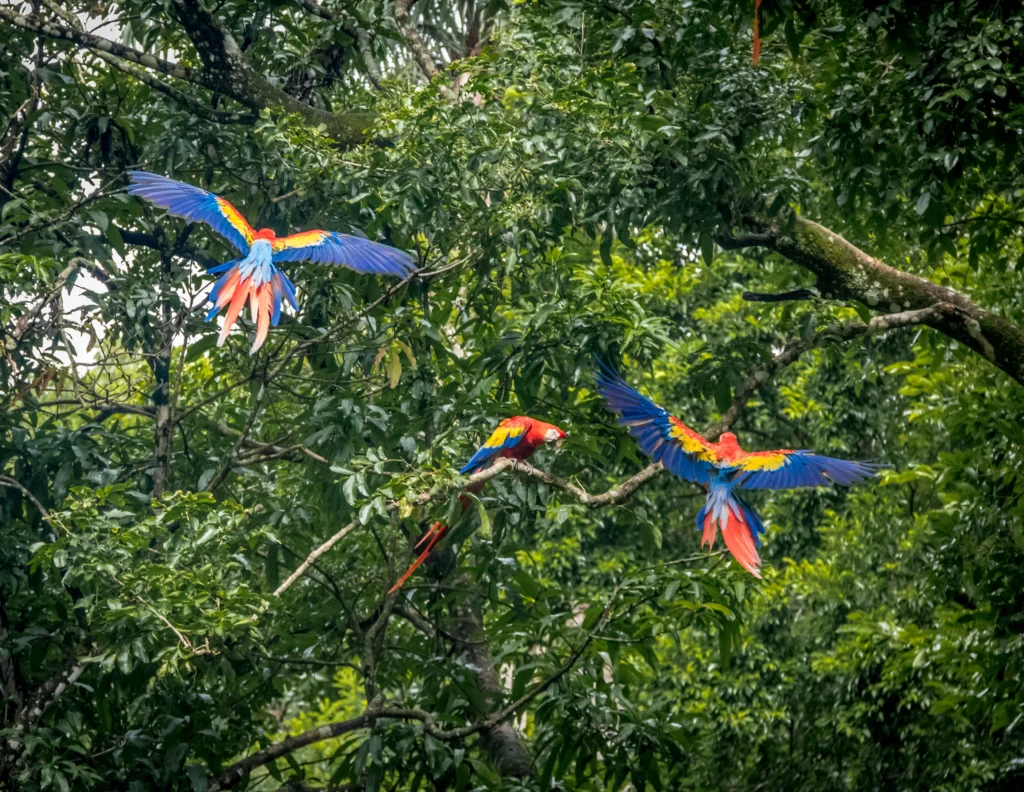
The scarlet macaw (Ara macao) is one of the most recognizable birds of the Amazon rainforest. It has bright red plumage, yellow and blue feathers on its wings, and a long red tail.
Its colorful appearance makes it one of the most photographed rainforest birds.
Scarlet macaws live in tropical forests from parts of Central America into South America, including the Amazon region. They spend much of their time in the forest canopy, searching for fruits, seeds, and nuts.
They are usually seen in pairs or small groups, although larger gatherings may occur around feeding areas.
Scarlet macaws use their powerful beaks to crack hard food and their feet to hold it while eating. They also communicate through loud calls that can be heard over long distances.
2. Blue-and-Yellow Macaw
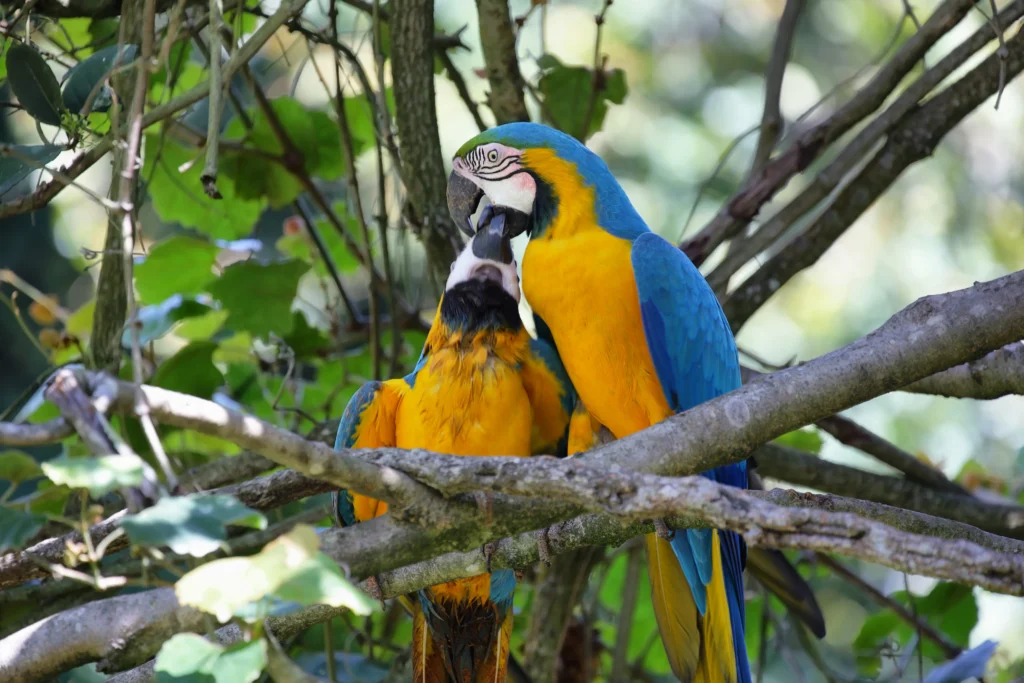
The blue-and-yellow macaw (Ara ararauna), also called the blue-and-gold macaw, is another well-known Amazonian parrot.
It has bright blue upperparts, golden-yellow underparts, a green forehead, and a strong black beak.
These macaws are often seen flying above the forest canopy in pairs. They are social birds that may gather in larger groups near food sources.
Their diet includes palm nuts, fruits, seeds, and other plant materials. Their strong beaks allow them to open hard-shelled foods that many smaller birds cannot access.
Blue-and-yellow macaws often use large tree cavities for nesting. They may return to suitable nesting areas over multiple breeding seasons.
3. Red-and-Green Macaw
The red-and-green macaw (Ara chloropterus) is one of the largest macaw species found in the Amazon region.
It has a mostly red body, green wing coverts, blue flight feathers, and a long tail. Its facial skin is largely white, with fine lines of red feathers.
This species is sometimes confused with the scarlet macaw because both have predominantly red plumage. However, the red-and-green macaw has more extensive green coloration on its wings.
It inhabits tropical forests and feeds on fruits, seeds, and nuts. Its powerful beak helps it open food with hard shells.
Red-and-green macaws are often observed in pairs or small groups and may gather at clay licks.
4. Blue-Headed Macaw
The blue-headed macaw (Primolius couloni) is a smaller macaw associated with parts of the western Amazon region, particularly Peru and neighboring areas.
It has a blue head, green body, and a relatively long tail. Compared with the larger macaws, it is less frequently encountered and can be more difficult to observe in the wild.
It inhabits humid tropical forests and feeds on seeds, fruits, and other plant materials.
The species is classified as Vulnerable on the IUCN Red List, making habitat protection and responsible conservation particularly important.
5. Red-Shouldered Macaw
The red-shouldered macaw (Diopsittaca nobilis) is one of the smallest macaws.
It has predominantly green feathers, a blue crown, and noticeable red patches on its wings. It is sometimes called the noble macaw.
Unlike the large scarlet and red-and-green macaws, this species is smaller and can be found in open woodland, palm groves, and forest-edge habitats in parts of northern and central South America, including areas of the Amazon region.
It feeds on seeds, fruits, flowers, and other plant materials. Its smaller size allows it to use a variety of feeding and nesting locations.
6. Chestnut-Fronted Macaw
The chestnut-fronted macaw (Ara severus) is a medium-sized macaw found in parts of Central and South America, including the Amazon Basin.
It has mostly green plumage, a chestnut-colored forehead, blue feathers on the wings, and a long tail.
It can live in humid forests, woodland areas, and forest edges. Chestnut-fronted macaws feed on fruits, seeds, nuts, and other vegetation.
Although they are smaller than some of the largest macaw species, they have strong beaks and are capable of cracking hard food.
What Do Macaws Eat in the Amazon?
Macaws are primarily plant-eating birds. Their diet varies depending on the species, season, and availability of food.
Common foods include:
- Palm nuts
- Fruits
- Seeds
- Berries
- Tree nuts
- Flowers
- Young plant material
Some species also consume insects or other small food items occasionally, but plant material makes up most of their diet.
Why Do Macaws Eat Hard Nuts?
Macaws have strong, curved beaks designed to crack hard shells. This allows them to access food that may be difficult for other birds to eat.
They also use their feet to hold nuts and fruits while breaking them open.
Their feeding habits help distribute seeds throughout the forest. Some seeds may be dropped during feeding or carried to other locations, contributing to plant regeneration.
Why Do Macaws Visit Clay Licks?
One of the most fascinating behaviors of Amazonian macaws is their visits to natural clay licks.
A clay lick is an exposed area of mineral-rich soil, often found along riverbanks or forest slopes. Macaws and other wildlife gather at these locations to consume small amounts of clay.
The exact benefits of clay consumption are still being studied. One widely discussed explanation is that clay provides minerals such as sodium, which may be limited in some rainforest foods.
Another possible benefit is that certain clay minerals may help bind naturally occurring plant compounds in the digestive system.
Famous Amazon Clay Lick Locations
Some of the best-known macaw clay licks are found in Peru, particularly in the Tambopata region.
The Tambopata National Reserve and nearby protected areas are famous for large gatherings of colorful macaws and parrots.
Visitors may see scarlet macaws, blue-and-yellow macaws, and red-and-green macaws gathering at clay banks, especially during favorable feeding conditions.
These locations are important for wildlife tourism and scientific research.
How Do Macaws Communicate?
Macaws are vocal birds with a wide range of calls. Their sounds include loud squawks, screeches, and contact calls.
Their vocal communication serves several purposes.
Maintaining contact: Pairs and flock members use calls to stay connected while flying or feeding.
Warning signals: Loud calls can alert other birds to potential threats.
Social interaction: Vocalizations help birds communicate during group activities.
Pair bonding: Mated pairs may communicate regularly and remain close to each other.
Macaws also use body movements, feather displays, and beak movements as part of their social behavior.
Their loud calls are one reason they are often heard before they are seen in the dense rainforest.
How Do Macaws Reproduce?
Macaws generally form long-term pair bonds. Many species remain with the same partner over multiple breeding seasons.
During breeding, pairs search for suitable nesting locations, often using natural cavities in large trees.
Nesting
Macaws usually nest in tree cavities created naturally or by decay, broken branches, and other processes. Suitable nesting sites can be limited, particularly in areas where large trees have been removed.
The female generally lays a small clutch of eggs, although the number varies by species.
Raising Chicks
The female usually spends significant time incubating the eggs, while the male helps by bringing food.
After hatching, chicks depend on their parents for warmth, protection, and food.
Both parents may contribute to feeding the young. The chicks remain in the nest until they are developed enough to leave.
Young macaws may continue to depend on their parents for some time after fledging as they develop their flying and feeding skills.
Because macaws generally reproduce slowly and may raise only a small number of young successfully, population recovery can be difficult when adult birds or nesting sites are lost.
What Role Do Macaws Play in the Amazon Ecosystem?
Macaws are more than colorful rainforest birds. They contribute to the health and functioning of their environment.
1. Seed Dispersal
Macaws feed on fruits and nuts and may carry seeds away from the parent plant. Seeds can be dropped or dispersed during feeding and movement.
This can help support plant regeneration and maintain forest diversity.
2. Supporting Forest Biodiversity
By feeding on different plant species, macaws participate in the complex relationships that connect trees, fruits, seeds, and wildlife.
Their presence is part of a healthy and diverse rainforest ecosystem.
3. Supporting Ecotourism
Macaws are among the most popular wildlife attractions in the Amazon.
Birdwatchers, photographers, and nature travelers visit rainforest lodges and protected areas to observe them.
Responsible ecotourism can support local employment and provide financial incentives for protecting natural habitats.
Are Amazon Macaws Endangered?
Not every macaw species has the same conservation status. Some populations remain relatively widespread, while others face serious threats.
The main challenges affecting Amazonian macaws include habitat destruction, illegal wildlife trade, hunting, and changes in forest conditions.
1. Deforestation
Deforestation is one of the biggest threats to macaws.
Large areas of rainforest are cleared for agriculture, cattle ranching, mining, logging, and infrastructure development.
When large trees disappear, macaws lose feeding areas and suitable nesting cavities.
2. Illegal Wildlife Trade
Macaws are attractive because of their colorful feathers and ability to mimic sounds.
Unfortunately, this has made some species targets for illegal capture and trade.
Removing young birds from nests can reduce breeding success and affect wild populations.
3. Habitat Fragmentation
When forests are divided into smaller sections, macaws may have difficulty moving between feeding and nesting areas.
Fragmented habitats can also increase exposure to human activity and reduce access to suitable nesting trees.
4. Hunting and Human Disturbance
In some areas, macaws are affected by hunting and disturbance near nesting sites.
Repeated disturbance can cause breeding birds to abandon nests, particularly when suitable nesting locations are limited.
5. Climate Change
Climate change may affect rainfall patterns, forest conditions, and the availability of fruits and seeds.
Changes in seasonal food availability can influence breeding success and survival.
How Can We Protect Macaws of the Amazon?
Protecting macaws requires long-term efforts to preserve rainforest habitats and reduce harmful human activities.
Important conservation measures include:
- Protecting old-growth rainforest and nesting trees.
- Supporting protected areas and responsible ecotourism.
- Preventing illegal capture and wildlife trafficking.
- Restoring degraded forest habitats.
- Supporting research and population monitoring.
- Educating local communities and visitors.
- Reducing the environmental impact of agriculture and development.
Visitors can also contribute by choosing responsible wildlife experiences. Avoid purchasing wild-caught parrots, do not disturb nesting birds, and follow local wildlife-viewing guidelines.
Supporting conservation organizations and sustainable rainforest tourism can help create economic reasons to protect natural habitats.
Where Can You See Macaws in the Amazon?
The Amazon offers several opportunities to observe macaws in their natural environment.
Some popular wildlife destinations include:
Tambopata National Reserve, Peru: Known for its clay licks and large gatherings of parrots and macaws.
Manu National Park, Peru: A protected rainforest region with exceptional bird diversity and opportunities to observe several macaw species.
Yasuní National Park, Ecuador: One of the most biodiverse areas of the Amazon, with a wide range of rainforest birds.
Cuyabeno Wildlife Reserve, Ecuador: Known for its flooded forests, rivers, lagoons, and diverse wildlife, including colorful parrots and macaws.
Brazilian Amazon: Several regions of the Brazilian Amazon provide habitat for scarlet, blue-and-yellow, and red-and-green macaws.
Wildlife sightings depend on the season, location, weather, and availability of food. A local naturalist guide can help visitors identify species and observe them without disturbing their behavior.
Frequently Asked Questions About Macaws of the Amazon
1. What types of macaws live in the Amazon rainforest?
Several species are found in the Amazon region, including scarlet macaws, blue-and-yellow macaws, red-and-green macaws, chestnut-fronted macaws, red-shouldered macaws, and blue-headed macaws.
2. What do Amazon macaws eat?
Macaws mainly eat fruits, nuts, seeds, berries, palm nuts, and other plant materials. Their strong beaks help them open hard-shelled foods.
3. Why do macaws eat clay?
Macaws visit clay licks to consume mineral-rich soil. Researchers believe this may help provide minerals and potentially bind certain plant compounds during digestion.
4. Are macaws native to the Amazon rainforest?
Several macaw species are native to the Amazon Basin, although macaws as a group also live in other parts of Central and South America.
5. How long do macaws live?
Lifespan varies by species and living conditions. Large macaws can live for several decades, and some individuals in managed care may reach 50 years or more. Lifespan in the wild can be affected by food availability, predators, disease, and habitat conditions.
6. Are macaws intelligent?
Yes. Macaws are highly intelligent parrots. They can learn complex behaviors, solve problems, recognize social relationships, and communicate using different calls and body movements.
7. Do macaws mate for life?
Many macaw species form long-term pair bonds and may remain with the same partner for many years. However, pair relationships can change due to death, separation, or other circumstances.
8. Why are macaws important to the Amazon rainforest?
Macaws contribute to seed movement, interact with many plant species, and form part of the rainforest food web. They also support ecotourism and conservation awareness.
9. Are Amazon macaws endangered?
Some Amazonian macaw species face significant conservation threats, while others have more stable populations. Habitat loss and illegal wildlife trade are major concerns. Conservation status should be checked separately for each species.
10. Where is the best place to see macaws in the Amazon?
Tambopata in Peru is especially famous for its clay licks and large parrot gatherings. Other good destinations include Manu National Park in Peru, Yasuní National Park and Cuyabeno Wildlife Reserve in Ecuador, and parts of the Brazilian Amazon.
Conclusion
Macaws are among the most remarkable birds of the Amazon rainforest. Their bright feathers, powerful beaks, intelligence, and social behavior make them an important part of the region’s wildlife. From the scarlet macaw to the blue-and-yellow and red-and-green macaws, each species contributes to the incredible diversity of the Amazon ecosystem.
These birds depend on healthy forests for food, shelter, and nesting sites. However, deforestation, illegal wildlife trade, and other environmental pressures continue to threaten their survival.
Protecting macaws means protecting the rainforest habitats they depend on. Through responsible tourism, habitat conservation, wildlife protection, and community involvement, we can help preserve these extraordinary birds for future generations.
For travelers exploring the Ecuadorian Amazon, staying at La Selva Eco Lodge & Retreat offers an opportunity to experience the rainforest and discover its remarkable birdlife. With guided nature experiences and access to the surrounding ecosystem, visitors can learn more about the wildlife that makes the Amazon one of the world’s most extraordinary natural environments.