When people think about the Amazon Rainforest, they often imagine towering trees, colorful birds, playful monkeys, and winding rivers. But hidden deep within this vast rainforest is one of the world’s most powerful and fascinating predators: the jaguar.
The jaguar is the largest wild cat in the Americas and one of the most iconic animals of the Amazon. Strong, intelligent, and incredibly elusive, this magnificent predator has ruled the rainforest for thousands of years. Although millions of people visit the Amazon hoping to see one, jaguars are rarely spotted because they are experts at staying hidden.
In this guide, you’ll learn everything you need to know about Amazon jaguars, including where they live, what they eat, how they hunt, why they are important, and where you might be lucky enough to see one in the wild.
What Is a Jaguar?
The jaguar is a large wild cat that belongs to the same family as lions, tigers, leopards, and snow leopards.
Its scientific name is Panthera onca.
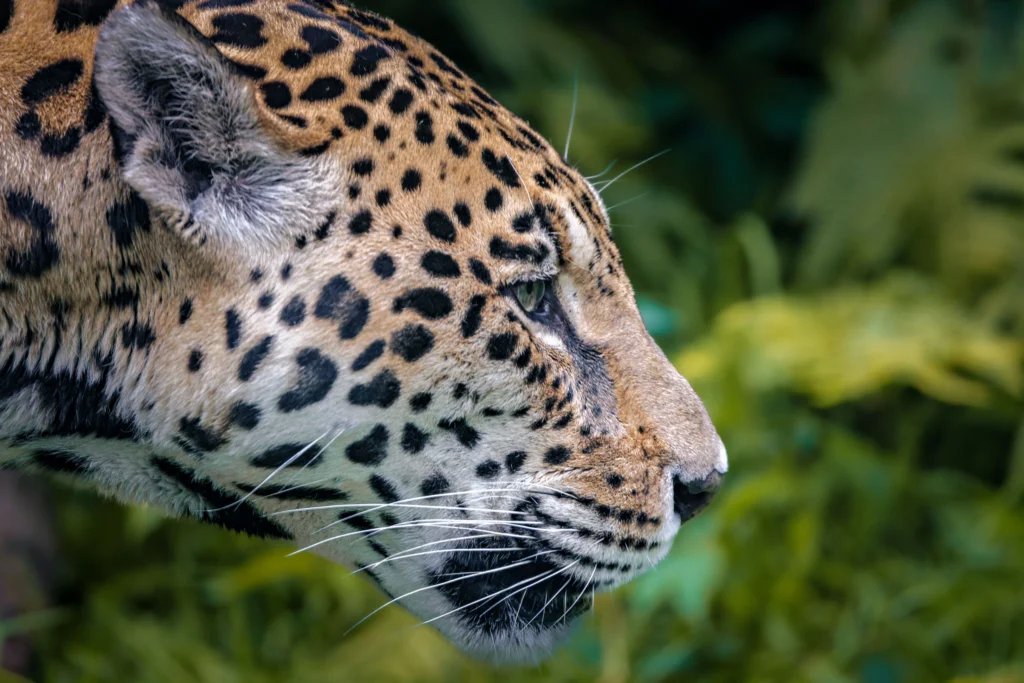
Jaguars are known for their muscular bodies, powerful jaws, and beautiful golden coats covered with black spots called rosettes. Every jaguar has a unique pattern, much like a human fingerprint.
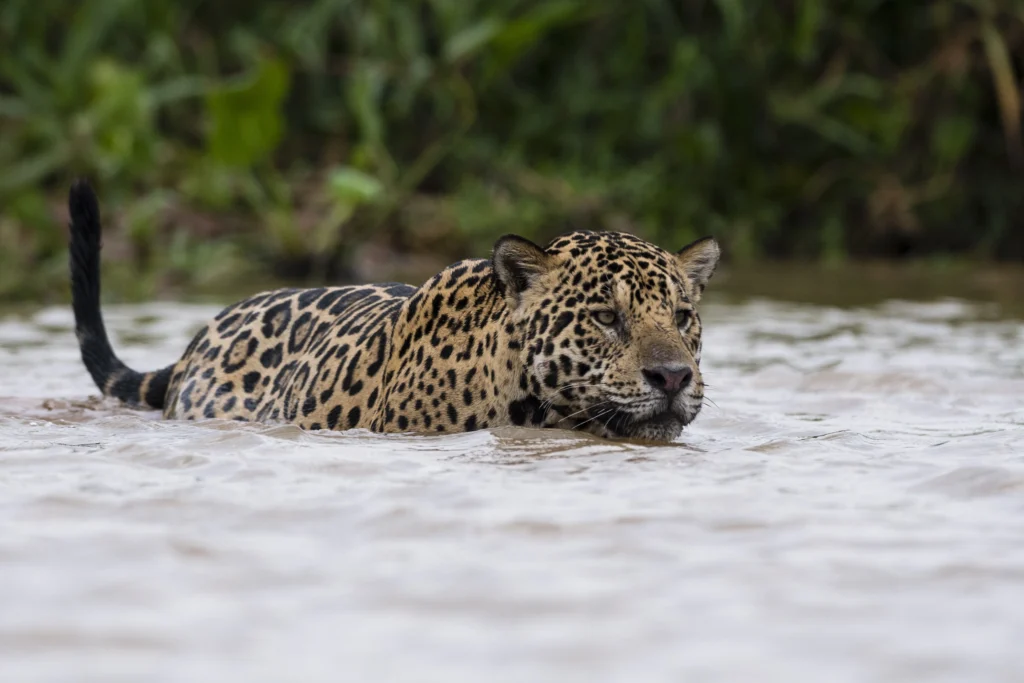
Unlike many other big cats, jaguars are excellent swimmers and spend a lot of time near rivers, lakes, and wetlands.
Where Do Jaguars Live?
Jaguars are found across Central and South America, but the Amazon Rainforest is their largest and most important home.
The Amazon stretches across several countries, including:
- Brazil
- Ecuador
- Peru
- Colombia
- Bolivia
- Venezuela
- Guyana
- Suriname
- French Guiana
The largest jaguar population lives in the Brazilian Amazon, but healthy populations can also be found in Ecuador, Peru, and other parts of the rainforest.
Because the Amazon is so large and dense, it provides the perfect habitat for these secretive cats.
Why Do Jaguars Like the Amazon Rainforest?
The Amazon offers everything a jaguar needs to survive.
It provides:
- Thick vegetation for hiding
- Plenty of rivers and streams
- A large variety of prey
- Safe places to raise cubs
- Large territories with little human disturbance
Unlike open grasslands, the rainforest allows jaguars to stalk prey without being seen.
Their spotted coats blend perfectly with sunlight filtering through the trees, making them almost invisible.
What Does a Jaguar Look Like?
Jaguars are powerful animals built for strength rather than speed.
Adult jaguars have:
- A muscular body
- Broad shoulders
- Strong legs
- A large head
- Small rounded ears
- Bright yellow or golden fur
- Black rosette-shaped markings
- A white belly
Some jaguars are almost completely black. These are often called black panthers, although they are actually jaguars with a genetic condition called melanism.
Even black jaguars still have rosette patterns that can be seen in bright light.
How Big Is a Jaguar?
Jaguars are the largest cats in the Americas.
Adults typically measure:
- Length: 5 to 6 feet, not including the tail
- Tail length: About 18 to 30 inches
- Weight: 100 to 250 pounds
Males are generally larger than females.
Jaguars living in areas with abundant prey often grow larger than those living in regions where food is less available.
Why Are Jaguars So Powerful?
The jaguar has one of the strongest bites of any big cat. Its jaw is powerful enough to bite through the skull of its prey or crush the hard shells of turtles.
This incredible bite force allows jaguars to hunt animals that many other predators would avoid.
Their strong muscles also help them drag heavy prey through the forest or into dense vegetation.
What Do Jaguars Eat?
Jaguars are carnivores, meaning they eat meat. Their diet is extremely varied because they are opportunistic hunters.
In the Amazon Rainforest, jaguars may hunt:
Scientists have recorded jaguars eating more than 80 different animal species.
This flexibility helps them survive in changing environments.
Do Jaguars Hunt in Water?
Yes.
Unlike most cats, jaguars love water. They are excellent swimmers and often hunt in rivers, lakes, and flooded forests.
They may catch:
- Fish
- Turtles
- Caimans
- River animals crossing the water
They can swim long distances and often cross rivers with ease.
Their comfort in water makes them unique among the world’s big cats.
How Do Jaguars Hunt?
Jaguars rely on patience rather than speed. Instead of chasing prey over long distances, they quietly stalk through the forest.
Their excellent hearing, eyesight, and sense of smell help them locate animals. Once close enough, the jaguar launches a sudden attack using its powerful legs.
Unlike lions that often attack the throat, jaguars frequently kill prey with a powerful bite to the skull or neck. This hunting technique allows them to quickly overpower even large animals.
Are Jaguars Active During the Day?
Jaguars are mostly active during:
- Early morning
- Late afternoon
- Night
However, they may hunt during the day if food is available.
The time they are most active often depends on weather, prey movement, and human activity.
Because they avoid people whenever possible, daytime sightings are uncommon.
How Fast Can a Jaguar Run?
Although jaguars are not built for long-distance running, they can reach speeds of around 50 miles per hour (80 km/h) over short distances.
They depend more on stealth than speed.
Most attacks happen after the jaguar has quietly approached within just a few feet of its prey.
This hunting style saves energy and increases the chance of success.
Are Jaguars Dangerous to Humans?
Healthy wild jaguars generally avoid people. Attacks on humans are extremely rare.
Most jaguars choose to leave the area if they become aware of human presence. Problems usually occur only if a jaguar feels trapped, threatened, or is protecting its cubs. Visitors exploring the Amazon with experienced guides have very little reason to fear jaguars.
In fact, seeing one in the wild is considered a very rare and special experience.
Why Are Jaguars So Hard to Spot?
Many visitors spend days exploring the Amazon without seeing a jaguar. This is because they are naturally shy and extremely well camouflaged.
Their spotted coats blend into the rainforest, allowing them to disappear among trees, vines, and shadows.
Jaguars also have very large territories and move quietly through the forest.
Most people never realize a jaguar has been nearby.
Why Are Jaguars Important?
Jaguars are known as apex predators, meaning they sit at the top of the food chain.
They help keep the rainforest healthy by controlling populations of herbivores and other animals.
Without predators like jaguars, prey populations could grow too quickly, damaging plants and affecting the balance of the ecosystem.
Protecting jaguars also protects countless other species that share their habitat. Their presence is a sign of a healthy rainforest.
Behavior of Jaguars
Jaguars are solitary animals. This means they prefer to live and hunt alone rather than in groups. Adult jaguars usually spend most of their lives by themselves, except during the breeding season or when a mother is raising her cubs.
Each jaguar has its own territory, which it marks using scent, scratches on trees, and vocal calls. These markings let other jaguars know that the area is already occupied.
Male jaguars usually have larger territories than females. A male’s territory may overlap with the territories of several females, but two adult males rarely share the same area.
Although jaguars are powerful predators, they spend much of their time resting. They often sleep during the hottest hours of the day and become more active when temperatures are cooler.
How Do Jaguars Communicate?
Jaguars communicate in several different ways.
One of the most common methods is through vocal sounds. They make deep, loud calls that are often described as roaring, coughing, or grunting. These calls help them attract mates and warn other jaguars to stay away from their territory.
Jaguars also communicate by:
- Leaving scent marks on trees and plants
- Scratching tree trunks with their claws
- Leaving tracks along forest trails
- Using body language during close encounters
Even though they are quiet animals most of the time, these forms of communication help them avoid unnecessary fights.
Breeding and Mating
Jaguars can breed throughout the year, although the timing often depends on food availability.
When a female is ready to mate, she attracts nearby males using scent and vocal calls.
After mating, the male usually leaves, and the female raises the cubs on her own.
This allows the mother to focus on protecting and caring for her young without competition for food.
Jaguar Cubs
A female jaguar usually gives birth to one to four cubs, with two being the most common.
The cubs are born blind and completely dependent on their mother. They stay hidden in a safe den during the first few weeks of life.
Possible den sites include:
- Thick vegetation
- Hollow logs
- Rocky caves
- Dense patches of forest
The mother keeps the cubs hidden from predators while she hunts for food.
As they grow older, the cubs become more curious and begin exploring the area around the den.
How Do Young Jaguars Learn to Hunt?
Learning to hunt is one of the most important parts of a young jaguar’s life.
When the cubs are old enough, they begin following their mother as she searches for prey.
She teaches them how to:
- Move quietly through the forest
- Stay hidden from prey
- Recognize different animals
- Stalk before attacking
- Use their powerful bite effectively
This learning process can take many months.
Young jaguars usually stay with their mother for up to two years before leaving to establish territories of their own.
How Long Do Jaguars Live?
In the wild, jaguars usually live between 12 and 15 years, although some may live longer if food is plentiful and they avoid injuries.
Jaguars living in protected areas often have a better chance of reaching an older age because they face fewer threats from humans.
Natural Enemies
Adult jaguars have very few natural enemies.
Because they are apex predators, very few animals are capable of attacking a healthy adult jaguar.
Young cubs, however, are much more vulnerable.
Possible dangers include:
- Large snakes
- Caimans
- Other jaguars
- Disease
- Starvation
The mother plays an important role in protecting her cubs during their early months.
Threats to Jaguars
Although jaguars are powerful predators, they face many challenges.
Habitat Loss
One of the biggest threats is the destruction of rainforest habitat.
Trees are cleared for:
- Farming
- Roads
- Cattle ranching
- Logging
- Human settlements
As forests disappear, jaguars lose places to hunt, rest, and raise their young.
Habitat loss also separates jaguar populations, making it harder for them to find mates.
Human Conflict
Sometimes jaguars hunt livestock when natural prey becomes scarce.
This can lead to conflict with farmers, who may see jaguars as a threat.
Conservation groups work with local communities to find ways to reduce these conflicts while protecting both people and wildlife.
Illegal Hunting
Although hunting jaguars is illegal in many areas, poaching still occurs.
Some jaguars are killed because of conflict with livestock, while others are targeted for their teeth, claws, or fur.
Strict wildlife protection laws help reduce illegal hunting, but continued enforcement remains important.
Climate Change
Changing weather patterns may also affect jaguar habitats.
Long periods of drought or flooding can change the availability of prey and alter parts of the rainforest.
Scientists continue studying how climate change may affect jaguar populations in the future.
Conservation Efforts
Many organizations work to protect jaguars and their habitats throughout South America.
Conservation efforts include:
- Protecting rainforest habitats
- Creating wildlife corridors between forests
- Reducing illegal hunting
- Monitoring jaguar populations
- Educating local communities
- Supporting sustainable tourism
National parks and protected reserves play an important role in helping jaguar populations survive.
Where Can You See Jaguars in the Amazon?
Although jaguars are difficult to find, some areas offer better chances than others.
Wildlife enthusiasts often visit parts of:
- Ecuador
- Peru
- Brazil
In Ecuador, guided tours through protected areas of the Amazon provide opportunities to explore prime jaguar habitat.
While sightings are never guaranteed, experienced naturalist guides can identify tracks, claw marks, and other signs that indicate jaguars are nearby.
Many visitors also use camera traps to capture images of these elusive cats.
Best Time to Look for Jaguars
Jaguars are most active during cooler parts of the day.
The best times for wildlife viewing include:
- Early morning
- Late afternoon
- Evening
Boat rides along rivers may increase your chances because jaguars often travel near the water in search of prey.
Even if you do not see a jaguar, you may discover footprints, scratch marks, or fresh tracks along muddy riverbanks.
Fun Facts About Amazon Jaguars
Here are some interesting facts about these incredible cats:
- Jaguars have the strongest bite of any big cat relative to their size.
- Every jaguar has a unique pattern of rosettes.
- They are excellent swimmers and often hunt in rivers.
- They can climb trees with ease.
- Jaguars have been recorded eating more than 80 different animal species.
- They are the largest wild cats in the Americas.
- Black jaguars are simply jaguars with a rare dark color variation.
- They can drag prey that weighs more than they do.
- Jaguars are usually shy and avoid people.
- A healthy jaguar population is a sign of a healthy rainforest.
FAQs About Amazon Jaguars
What is the difference between a jaguar and a leopard?
Jaguars are larger and more muscular than leopards. They also have stronger jaws and rosette-shaped spots with a small dot in the center, while leopard rosettes usually do not have central spots.
How many jaguars are estimated to live in the Amazon Rainforest?
The Amazon Rainforest is home to the largest remaining jaguar population in the world, with tens of thousands believed to live across its vast forests, though exact numbers are difficult to determine.
Can jaguars climb trees?
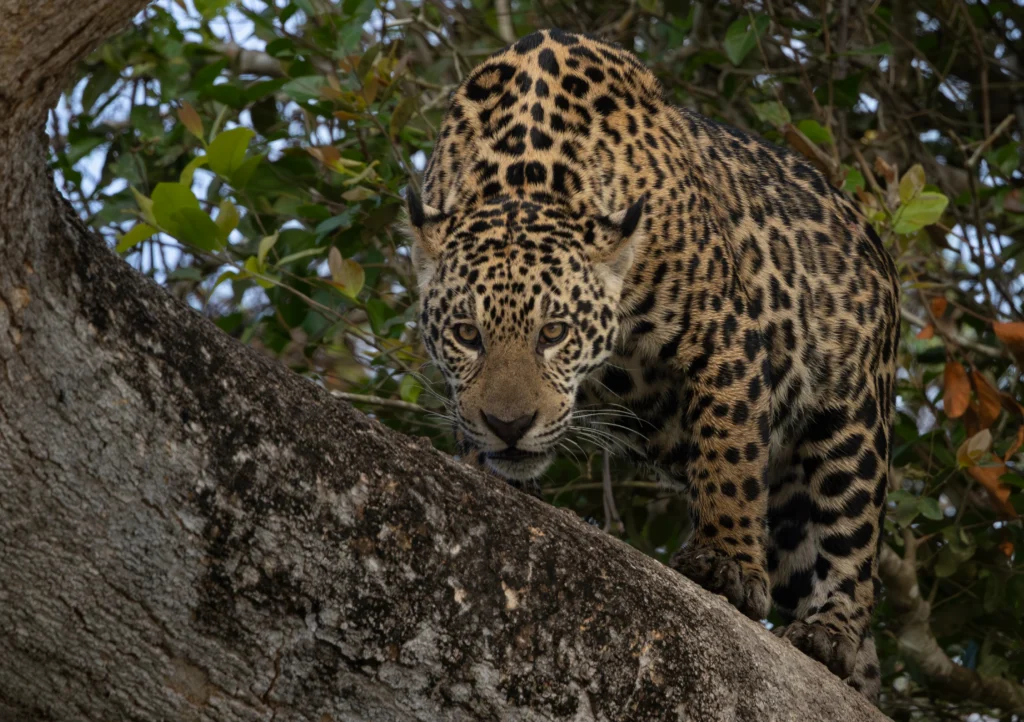
Yes. Jaguars are skilled climbers and often climb trees to rest, scout their surroundings, or keep prey away from other animals.
Do jaguars hunt every day?
Not necessarily. After making a large kill, a jaguar may feed on it for several days before hunting again.
Why are jaguars considered umbrella species?
Protecting jaguars also protects the large areas of rainforest they need to survive, which benefits countless other plants and animals living in the same ecosystem.
What is the biggest prey a jaguar can hunt?
Jaguars can hunt large animals such as tapirs, capybaras, and caimans. Their powerful bite allows them to take down prey that many other predators avoid.
Are jaguars good swimmers compared to other big cats?
Yes. Jaguars are among the best swimmers of all big cats and are comfortable crossing rivers, hunting in water, and exploring flooded forests.
What should you do if you encounter a jaguar in the wild?
Stay calm, avoid running, keep your distance, and slowly back away while facing the animal. Most jaguars avoid humans and will leave if they do not feel threatened.
Are jaguars protected by law?
Yes. Jaguars are protected in many countries throughout their range, and hunting them is illegal in most areas. Conservation programs also work to preserve their habitat.
Why is seeing a jaguar in the Amazon so special?
Jaguars are highly secretive and have excellent camouflage, making them one of the hardest animals to spot in the rainforest. A wild jaguar sighting is considered a rare and unforgettable wildlife experience.
Conclusion
The jaguar is one of the most impressive animals in the Amazon Rainforest. With its incredible strength, silent hunting skills, powerful bite, and ability to thrive in both forests and waterways, it truly deserves its reputation as the king of the Amazon.
Beyond its beauty and power, the jaguar plays a vital role in maintaining the balance of the rainforest ecosystem. By controlling prey populations, it helps keep the forest healthy and supports countless other species that share its habitat.
If you’re planning a trip to the Ecuadorian Amazon, visiting a remote eco-lodge with experienced naturalist guides gives you the chance to explore one of the world’s best wildlife destinations. While spotting a jaguar is never guaranteed, simply walking through its habitat, seeing fresh tracks, or knowing one may be nearby is an unforgettable experience that highlights the incredible biodiversity of the Amazon Rainforest.