The harpy eagle is one of the most powerful birds of prey in the world. Found in the tropical forests of Central and South America, this impressive bird is especially associated with the Amazon rainforest. It is known for its enormous talons, broad wings, strong body, and distinctive crown of feathers on its head.
The harpy eagle is a top predator in its forest habitat. It hunts animals that live in trees, including sloths and monkeys, using its excellent eyesight, powerful feet, and ability to fly through dense forest. Unlike many birds of prey that hunt in open areas, the harpy eagle is adapted to life beneath the rainforest canopy.
Despite its strength, the harpy eagle faces serious challenges. Deforestation, habitat fragmentation, hunting, and human disturbance threaten populations in several parts of its range. Protecting large areas of tropical forest is essential for the survival of this remarkable bird.
This guide covers everything you need to know about the harpy eagle of the Amazon, including its physical characteristics, habitat, diet, hunting behavior, reproduction, lifespan, ecological importance, and conservation.
Key Takeaways
- The harpy eagle is a powerful bird of prey native to Central and South America.
- Its scientific name is Harpia harpyja.
- The Amazon rainforest is one of its most important habitats.
- Females are generally larger than males.
- Its diet includes sloths, monkeys, and other tree-dwelling animals.
- Its broad wings, excellent eyesight, and strong talons help it hunt in dense forests.
- Harpy eagles build large nests in tall trees and raise their young slowly.
- They play an important role as predators in tropical forest ecosystems.
- Deforestation, hunting, habitat fragmentation, and the loss of nesting trees threaten their survival.
- Protecting mature rainforests and working with local communities are essential for conservation.
What Is a Harpy Eagle?
The harpy eagle is a large bird of prey belonging to the family Accipitridae, which also includes hawks, kites, and many other eagles. Its scientific name is Harpia harpyja.
It is one of the largest and most powerful eagles found in tropical forests. The species lives in Central and South America, with important populations in the Amazon Basin.
Harpy eagles spend much of their time in mature forests, where tall trees provide nesting sites and a suitable environment for hunting. They are specially adapted to capture prey that lives in the forest canopy and on tree branches.
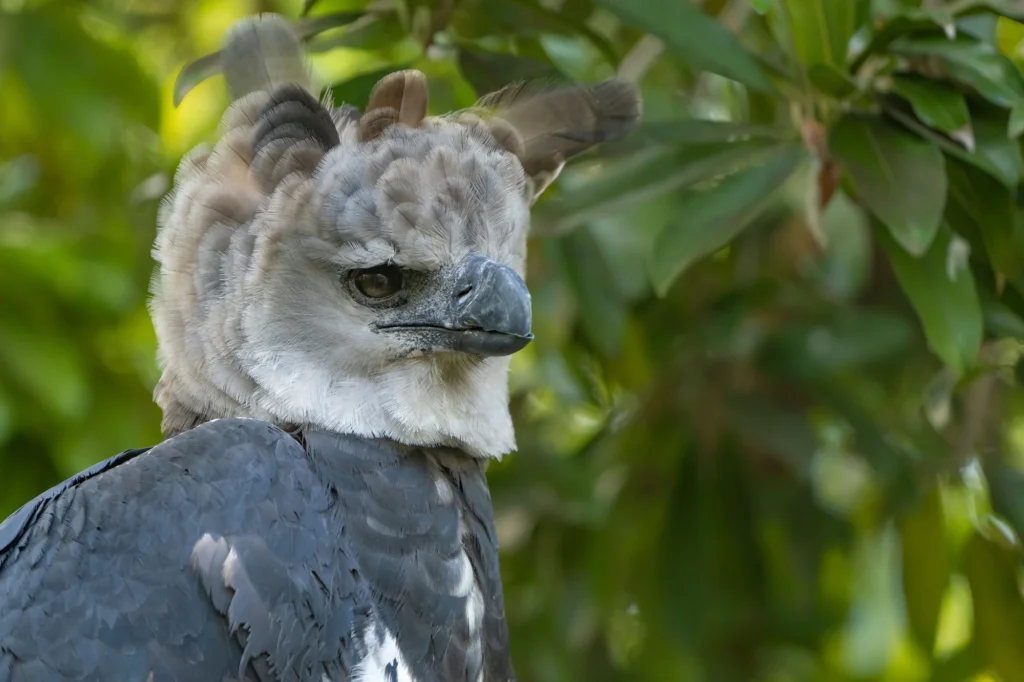
One of the most recognizable features of the harpy eagle is its double crest of feathers. When the bird becomes alert or excited, it can raise these feathers, creating a distinctive crown-like appearance.
Harpy eagles are carnivores, meaning they eat other animals. Their diet includes tree-dwelling mammals such as sloths and monkeys, along with certain birds and other suitable prey.
Although their appearance can seem intimidating, harpy eagles generally avoid people. They are wild predators that play an important role in maintaining the balance of rainforest ecosystems.
Physical Characteristics of the Harpy Eagle
Harpy eagles have several physical features that make them effective hunters in dense tropical forests.
1. Large Body Size
Harpy eagles are among the largest eagles in the Americas. Adult females are generally larger and heavier than males, which is a common pattern among many birds of prey.
Females may weigh around 6 to 9 kilograms, while males often weigh approximately 4 to 5.5 kilograms. Individual measurements vary.
Adults commonly have a wingspan of around 1.8 to 2 meters. Although some eagles have wider wingspans, the harpy eagle’s relatively shorter, broad wings help it maneuver through forest vegetation.
2. Powerful Talons
The harpy eagle has exceptionally strong feet and long, curved talons. These are among its most important hunting tools.
Its feet help it grip and carry prey, including mammals that can be surprisingly large compared with the bird itself.
The talons are designed to hold struggling animals securely. This allows the eagle to capture prey while reducing the risk of losing it during the hunt.
3. Distinctive Feathered Crest
The harpy eagle has a double crest of feathers on the back of its head. When raised, the crest gives the bird a dramatic appearance.
The crest may be displayed when the bird is alert or responding to its surroundings. It is one of the easiest features to recognize when identifying a harpy eagle.
4. Strong Beak
Its large, hooked beak helps tear meat into smaller pieces. Like other birds of prey, the harpy eagle uses its feet to capture prey and its beak to feed.
The hooked shape is suited to tearing flesh rather than chewing food.
5. Excellent Eyesight
Harpy eagles have excellent vision that helps them detect movement among leaves and branches. This is particularly important in the Amazon rainforest, where prey may be difficult to see through thick vegetation.
Their vision allows them to locate animals from perches high in trees and to assess opportunities for hunting.
6. Broad Wings and a Long Tail
Harpy eagles have broad wings and a relatively long tail that help them maneuver around trees.
These features are useful in a forest where narrow gaps, branches, and dense foliage make flight more difficult than in open landscapes.
Their flight adaptations help them move between perches and approach prey with limited warning.
Where Does the Harpy Eagle Live?
The harpy eagle lives in tropical forests across parts of Central and South America. Its range extends from southern Mexico through Central America and into countries such as Colombia, Ecuador, Peru, Bolivia, Brazil, Guyana, Suriname, and French Guiana.
The Amazon rainforest is one of its most important habitats.
Harpy eagles generally prefer large areas of mature forest containing tall trees. These forests provide the branches needed for hunting, the large trees needed for nesting, and the animals that make up their diet.
Their habitat includes:
- Lowland tropical rainforests.
- Mature forests with tall canopy trees.
- Forested river basins.
- Large, connected areas of woodland.
- Forest landscapes with suitable nesting and hunting territories.
Harpy eagles may also occur in some forested areas outside the Amazon Basin. However, they depend heavily on healthy tropical forest environments.
Why Does the Harpy Eagle Need Large Forests?
Harpy eagles require more than a small patch of trees. They need enough space to find prey, establish territories, and raise their young.
They often rely on large trees for nesting. When these trees are removed, suitable nesting sites become less available.
Forest fragmentation can also separate populations and make it harder for eagles to find food. Even when some trees remain, a fragmented landscape may not provide everything needed to support successful breeding.
Protecting large, connected forest areas is therefore important for the long-term survival of the species.
What Does the Harpy Eagle Eat?
The harpy eagle is a carnivore and one of the leading predators of tree-dwelling mammals in tropical forests.
Its diet varies according to the prey available in its territory. Much of its food comes from animals that spend considerable time in trees.
Common prey includes:
- Sloths.
- Monkeys.
- Opossums.
- Certain other arboreal mammals.
- Birds, including some large forest birds.
Sloths and monkeys are especially important prey in many parts of the harpy eagle’s range.
The eagle’s powerful legs and talons allow it to capture animals that may weigh several kilograms. However, it does not hunt every type of animal equally. Its feeding habits depend on local wildlife, hunting opportunities, and the needs of its growing chicks.
Why Does the Harpy Eagle Hunt Sloths?
Sloths are common in many tropical forest habitats and spend much of their lives in trees. Their slow movements can make them vulnerable when an eagle approaches successfully.
Harpy eagles use their vision to detect prey among branches and leaves. They may watch from a perch before making a rapid approach.
Their powerful feet allow them to grasp prey and carry it away from the hunting area.
Does the Harpy Eagle Eat Monkeys?
Yes. Monkeys are a significant part of the diet in many harpy eagle populations.
Hunting monkeys can be challenging because they are alert, mobile, and may live in groups. The eagle’s ability to approach through the canopy and strike quickly helps it capture prey.
How Much Food Does a Harpy Eagle Need?
The amount of food needed depends on the bird’s size, activity, age, and whether it is feeding chicks.
Adult females are larger than males and generally require more food. During the breeding season, adults may need to bring substantial amounts of prey to the nest.
Harpy eagles do not necessarily eat every day. Like many large predators, they can consume a large meal and then spend time resting before the next successful hunt.
How Does the Harpy Eagle Hunt?
The harpy eagle is adapted for hunting in thick forest rather than pursuing prey over long distances in open skies.
1. Hunting From a Perch
The eagle may sit quietly on a branch and observe its surroundings. This allows it to look for movement among the leaves without wasting unnecessary energy.
Its excellent eyesight helps it notice animals moving through the canopy.
2. Approaching Through the Trees
Once it identifies a potential target, the eagle may move rapidly through the forest vegetation.
Its broad wings and tail help it maneuver between branches. This is important because dense forests offer less open space than grasslands or coastal habitats.
3. Capturing Prey With Its Talons
When the eagle reaches its target, it uses its powerful feet and curved talons to grasp the animal.
The force of the grip helps it hold prey securely. Harpy eagles are capable of capturing relatively large mammals, making them formidable predators.
4. Carrying Food to the Nest
During the breeding season, adults may carry prey back to their nest to feed the chick.
Large prey may be consumed in stages or handled at a suitable location. The adults’ ability to find and deliver enough food is important for the chick’s survival.
Harpy Eagle Behavior and Daily Life
Harpy eagles are generally solitary or found in pairs. They spend much of their time within forest territories, where they hunt, rest, and raise their young.
1. Resting in Tall Trees
Harpy eagles often rest on branches within the forest canopy. Their large bodies and camouflage can make them difficult to spot from the ground.
They may remain still for long periods while watching for prey or conserving energy.
2. Living in Pairs
Adult harpy eagles form breeding pairs. Pairs may remain associated over long periods and use the same general territory across multiple breeding attempts.
Maintaining a suitable territory is important because both adults need access to prey and nesting trees.
3. Communicating Through Calls
Harpy eagles use vocalizations to communicate. Their calls can be important during courtship, territorial interactions, and communication between adults near the nest.
They are not constantly vocal. Much of their hunting behavior depends on remaining quiet and observing their surroundings.
4. Protecting Their Territory
Harpy eagles need access to sufficient food and suitable nesting sites. They may defend areas around their nests against potential threats.
Their territories can cover large areas, although the exact size varies with habitat quality and prey availability.
5. Avoiding Humans
Harpy eagles generally avoid direct contact with people. However, they may become defensive if people approach an active nest too closely.
Observing them from a safe distance is important for both human safety and the welfare of the birds.
How Do Harpy Eagles Reproduce?
Harpy eagles reproduce slowly compared with many smaller birds. Their breeding strategy involves considerable parental care and long periods of chick development.
1. Courtship and Nesting
Breeding pairs establish or maintain a nesting territory. They usually select a large tree that can support a substantial nest high above the forest floor.
Harpy eagle nests are made from branches and other plant material. They can become very large as adults add material over time and reuse suitable nesting sites.
2. Egg Laying
A female typically lays one or two eggs. However, although two eggs may be laid, it is common for only one chick to survive and develop fully.
Egg production and the success of a breeding attempt depend on several factors, including food availability and environmental conditions.
3. Incubation
The adults take part in protecting the eggs, with the female generally doing most of the incubation.
The incubation period lasts approximately 53 to 58 days, although individual breeding records can vary.
During this time, the adults must protect the nest and ensure that the eggs remain at suitable temperatures.
4. Hatching and Feeding
After hatching, the chick depends entirely on its parents for food and protection.
Adults bring prey to the nest and help the chick grow. Because the chick develops slowly, feeding and nest protection continue for many months.
5. Fledging
The young eagle eventually develops enough strength and coordination to leave the nest and begin flying.
Leaving the nest does not mean it is immediately independent. Young harpy eagles may continue to rely on their parents for food and support for several additional months.
6. Slow Reproduction
Harpy eagles do not generally raise large numbers of young every year. A breeding pair may take several years between successful breeding attempts.
This slow reproductive rate makes the species vulnerable to population losses. If an adult is killed or a nesting tree is destroyed, replacing the lost breeding bird may take a long time.
How Long Does a Harpy Eagle Live?
Harpy eagles are long-lived birds, although their exact lifespan in the wild is difficult to establish.
They may live for several decades under suitable conditions. However, lifespan depends on factors such as habitat quality, food availability, injuries, disease, and human-related threats.
Young eagles face particular challenges as they learn to hunt and become independent. Adults that survive these early stages may remain capable predators for many years.
Their slow reproduction means that the loss of an adult can have a significant effect on a local population, especially where only a few breeding pairs remain.
The Role of the Harpy Eagle in the Amazon Ecosystem
The harpy eagle plays an important role in the Amazon rainforest as a top predator.
1. Regulating Prey Populations
By hunting animals such as sloths and monkeys, harpy eagles contribute to the natural regulation of prey populations.
Predators influence ecosystem relationships, although the effects of any single species depend on many environmental factors.
2. Supporting Biodiversity
Healthy predator populations are part of a functioning rainforest ecosystem. The presence of harpy eagles can indicate that an area retains suitable forest habitat and sufficient prey.
However, seeing a harpy eagle alone does not prove that an ecosystem is completely healthy. Conservation assessments consider many species and environmental conditions.
3. Maintaining Food Webs
Harpy eagles occupy a high position in the food web. Their feeding relationships connect them with many other animals in the forest.
Changes in prey populations, forest structure, or nesting sites can affect the eagles, while changes in eagle numbers can influence some prey populations.
4. Serving as a Conservation Symbol
The harpy eagle is an important symbol of tropical forest conservation. Protecting its habitat also helps safeguard countless other species that depend on mature rainforest.
Because harpy eagles need large trees and healthy prey populations, efforts to protect them can benefit broader forest conservation goals.
What Is the Difference Between a Harpy Eagle and Other Eagles?
Harpy eagles differ from many other large eagles because they are specially adapted to hunting in tropical forests.
Harpy Eagle vs. Bald Eagle
The bald eagle lives mainly in North America and is closely associated with lakes, rivers, and coastal areas. Fish are a major part of its diet, although it also eats birds and mammals.
The harpy eagle lives in tropical forests of Central and South America and commonly hunts tree-dwelling mammals such as sloths and monkeys.
Bald eagles have a distinctive white head and tail as adults, while harpy eagles have a gray head, a feathered crest, and a dark body with a white underside.
Harpy Eagle vs. Golden Eagle
The golden eagle occurs across large areas of the Northern Hemisphere, including mountains, grasslands, and open country.
It commonly hunts mammals such as rabbits and hares, although its diet varies across its range.
The harpy eagle is adapted to tropical forest conditions and uses its broad wings and powerful feet to hunt within dense vegetation.
Harpy Eagle vs. Philippine Eagle
The Philippine eagle is another large forest eagle. It is native to the Philippines and is critically endangered.
Both species depend on forest habitats and hunt other animals, but they live in different parts of the world and belong to distinct evolutionary lineages.
Is the Harpy Eagle Endangered?
The harpy eagle is classified as Vulnerable on the International Union for Conservation of Nature’s Red List. Its status reflects the threats it faces across its range, although population trends differ between countries and regions.
The species remains present in parts of the Amazon, but habitat loss and human-related threats have caused declines in some areas.
1. Deforestation
Clearing forests for agriculture, cattle ranching, roads, mining, and other development removes suitable hunting and nesting habitat.
Because harpy eagles rely on large trees, the loss of mature forest can have a particularly serious effect.
2. Habitat Fragmentation
When continuous forest is divided into smaller patches, eagles may have less access to prey and suitable nesting sites.
Fragmentation can also isolate breeding pairs and reduce opportunities for populations to recover.
3. Hunting and Persecution
Harpy eagles may be killed by people because of fear, misunderstandings, or conflicts involving wildlife.
In some cases, people may mistakenly believe that these birds pose a serious threat to livestock or humans.
Education and community-based conservation can help reduce unnecessary killing.
4. Loss of Nesting Trees
Harpy eagles often depend on very large trees for nesting. Logging and forest clearance can remove these essential structures even when some surrounding vegetation remains.
A pair may lose a valuable breeding site when a single important tree is cut down.
5. Slow Reproduction
Harpy eagles raise young slowly and do not reproduce at the same rate as many smaller birds.
When adults die or breeding sites are destroyed, populations may take many years to recover.
Conservation Efforts to Protect Harpy Eagles
Protecting the harpy eagle requires a combination of habitat conservation, research, education, and community involvement.
1. Protecting Mature Rainforest
One of the most important conservation measures is protecting large areas of mature tropical forest.
This helps preserve nesting trees, prey populations, and the connected habitat that harpy eagles need.
2. Monitoring Nests and Populations
Researchers monitor nesting sites, breeding success, and the movement of individual birds.
These observations help scientists identify important breeding areas and assess whether populations are increasing or declining.
3. Environmental Education
Educational programs help communities understand the role of harpy eagles in the rainforest.
Teaching people about their diet, behavior, and ecological importance can reduce fear and discourage unnecessary killing.
4. Working With Local Communities
Conservation efforts are more effective when local communities participate in protecting forests and wildlife.
Programs may involve local guides, researchers, landowners, schools, and conservation organizations.
5. Protecting Wildlife Corridors
Forest corridors connect habitat patches and allow animals to move between them. Maintaining these connections can support wildlife populations and reduce the isolation caused by deforestation.
6. Supporting Responsible Ecotourism
Responsible wildlife tourism can create economic reasons to protect natural habitats. However, tours must avoid disturbing nesting birds or damaging sensitive forest areas.
Visitors should observe harpy eagles from a safe distance and follow the guidance of trained local guides.
Can You See a Harpy Eagle in the Amazon Rainforest?
Yes, harpy eagles can be seen in parts of the Amazon rainforest, but sightings are uncommon. They live in large forest areas and can be difficult to locate because they often remain high in the canopy.
Some specialized wildlife tours and research-based visits may offer opportunities to learn about harpy eagles and their habitat.
However, there is no guarantee of seeing one in the wild. The chances of a sighting depend on the location, season, local population, and the quality of the habitat.
Visitors interested in seeing harpy eagles should choose responsible operators who respect wildlife protection rules and do not disturb active nests.
The best approach is to treat a sighting as a special opportunity rather than an expected part of every Amazon tour.

Interesting Facts About the Harpy Eagle
Here are some fascinating facts about this powerful rainforest predator.
- It is one of the largest forest eagles. The harpy eagle is among the most powerful birds of prey found in tropical forests.
- Females are larger than males. Female harpy eagles generally weigh more and are larger than their male partners.
- It has enormous talons. Its feet and curved claws are specially adapted for capturing and holding prey.
- It hunts sloths and monkeys. These tree-dwelling mammals are important parts of its diet.
- It has a distinctive crest. The double crest of feathers on its head can be raised when the bird becomes alert.
- It is adapted to dense forests. Its broad wings and long tail help it maneuver through vegetation.
- It builds large nests. Breeding pairs use substantial nests in tall trees.
- It raises its young slowly. Chicks depend on their parents for an extended period.
- It needs mature forest. Large nesting trees and healthy prey populations are essential for successful breeding.
- It is an important rainforest predator. Its role in the food web makes it a valuable part of tropical forest ecosystems.
FAQs About the Harpy Eagle
1. What is the scientific name of the harpy eagle?
The scientific name of the harpy eagle is Harpia harpyja. It belongs to the family Accipitridae.
2. Where does the harpy eagle live?
The harpy eagle lives in tropical forests across parts of Central and South America. The Amazon rainforest is one of its most important habitats.
3. How big is a harpy eagle?
Adult females generally weigh around 6 to 9 kilograms, while males are often smaller, weighing approximately 4 to 5.5 kilograms. Their wingspan commonly reaches around 1.8 to 2 meters.
4. What does the harpy eagle eat?
Its diet includes sloths, monkeys, opossums, certain birds, and other animals that live in or around trees.
5. Why is the harpy eagle so powerful?
Its muscular legs, strong feet, curved talons, and hooked beak help it capture and handle prey. Its eyesight also helps it locate animals in dense vegetation.
6. Is the harpy eagle dangerous to humans?
Harpy eagles are powerful wild predators, but they generally avoid people. They may defend themselves or their nests if threatened, so observers should maintain a safe distance.
7. How long does a harpy eagle live?
Harpy eagles can live for several decades, although their exact lifespan in the wild is not well established for every population.
8. How many eggs does a harpy eagle lay?
A female typically lays one or two eggs. In many breeding attempts, only one chick survives to develop fully.
9. How long does a harpy eagle chick stay with its parents?
The chick remains in the nest for several months and may continue depending on its parents for food after fledging. The full period of parental dependence can extend well beyond the first flight.
10. Is the harpy eagle endangered?
The harpy eagle is classified as Vulnerable on the IUCN Red List. Deforestation, habitat fragmentation, hunting, and the loss of nesting trees threaten populations in parts of its range.
11. Can harpy eagles carry monkeys?
Yes. Harpy eagles can capture and carry certain monkeys, depending on the prey’s size and the bird’s own strength. Their powerful feet help them grip prey securely.
12. Why is the harpy eagle important to the Amazon rainforest?
It is a top predator that hunts animals such as sloths and monkeys. It also serves as an important symbol of mature rainforest conservation because it depends on healthy forests and suitable nesting trees.
Conclusion
The harpy eagle is one of the most remarkable predators of the Amazon rainforest. Its impressive size, powerful talons, excellent eyesight, and ability to hunt among dense trees make it uniquely adapted to life in tropical forests.
Beyond its physical strength, the harpy eagle plays an important role in the rainforest ecosystem. By hunting sloths, monkeys, and other animals, it contributes to the natural balance of the forest food web. Its dependence on mature trees also makes it an important species for understanding the effects of deforestation.
However, habitat loss and human-related threats continue to affect harpy eagle populations. Protecting large forest areas, preserving nesting trees, supporting research, and encouraging responsible ecotourism can help safeguard the species.
The survival of the harpy eagle is closely connected to the health of the Amazon rainforest. Protecting this extraordinary bird also means protecting the many other plants and animals that depend on one of the world’s most important tropical ecosystems.
Disclaimer – This article is for educational purposes. Wildlife populations and conservation assessments may change as new research becomes available. Consult current information from recognized conservation organizations for the latest scientific and conservation details.