The Amazon Rainforest is the largest rainforest on Earth. It spreads across Brazil, Peru, Colombia, Ecuador, Bolivia, Venezuela, Guyana, Suriname, and French Guiana. It is full of life, and one of the most interesting animals that live there is the monkey.
The Amazon has more kinds of monkeys than anywhere else in the world. Some are tiny enough to fit in your hand. Others are large and strong, with long tails that can hold their entire body weight. Some are loud and can be heard from miles away. Others are quiet and hard to spot.
This guide explains everything about Amazon rainforest monkeys in simple and clear language. You will learn about the different types, where they live, what they eat, how they raise their babies, how they survive, and why they are important.
What Makes Amazon Monkeys Special
All monkeys in the Amazon are called New World monkeys. They are different from monkeys in Africa and Asia.
Here are a few features that make them special:
- Their nostrils are wide and face sideways
- Many have tails that can grab branches
- Most live high in trees
- Many are smaller than monkeys in other parts of the world
A tail that can grab and hold things is called a prehensile tail. This tail works almost like an extra hand. It helps monkeys climb, swing, and balance in the trees.
Living in trees is called an arboreal lifestyle. Almost all Amazon monkeys spend most of their lives in the forest canopy.
The Main Types of Monkeys in the Amazon
There are many species, but most people group them into a few main types. Each type has its own habits and personality.
Howler Monkeys
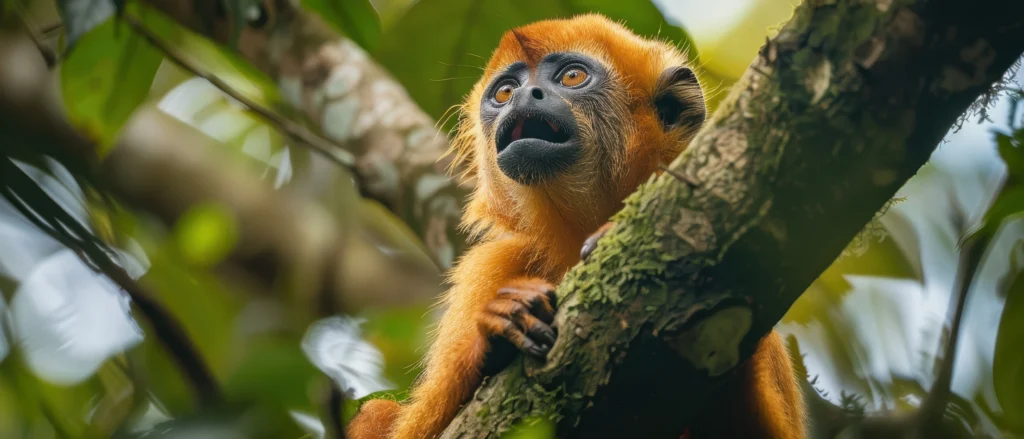
One of the most famous monkeys in the Amazon is the Red Howler Monkey.
Howler monkeys are known for their loud calls. Their deep roar can travel for several miles through the forest. Early explorers sometimes thought they were hearing large predators.
What They Look Like
- Medium to large size
- Thick fur, often red, brown, or black
- Strong prehensile tail
- Large throat area
They have a special throat bone that helps make their voice so loud.
How They Live
Howlers live in small family groups. They spend much of the day resting. Leaves are hard to digest, so they need time to process their food.
They mostly eat leaves, but they also eat fruit and flowers.
Their loud calls help them avoid fights. Instead of battling other groups, they shout to warn others to stay away.
Spider Monkeys
The Black Spider Monkey is one of the most graceful monkeys in the rainforest.
What They Look Like
- Long arms and legs
- Slim body
- Very long tail
- Small or missing thumbs
Their body shape helps them swing easily through trees.
How They Move
Spider monkeys are excellent climbers. They swing from branch to branch using their arms. Their tail acts like a fifth limb and helps them hang and balance.
What They Eat
They mainly eat ripe fruit. Because fruit trees are spread out, spider monkeys travel long distances every day.
They live in large groups that often split into smaller groups while searching for food. Later, they come back together.
Capuchin Monkeys
Capuchins are known as some of the smartest monkeys in the Amazon. The Brown Capuchin is one of the best known.
What They Look Like
- Medium size
- Strong jaws
- Expressive faces
Intelligence
Capuchins can use tools. They use stones to break open nuts. They have been seen using sticks to dig for insects.
They are curious and playful. They learn by watching each other.
Diet
Capuchins eat almost anything:
- Fruit
- Insects
- Nuts
- Eggs
- Small animals
Because they eat many types of food, they are called omnivores.
Squirrel Monkeys
The Common Squirrel Monkey is small and very active.
What They Look Like
- Small body
- Long tail
- Short fur
- Bright face markings
Social Life
Squirrel monkeys live in very large groups, sometimes more than 100 individuals.
Living in big groups helps protect them from predators.
Diet
They eat insects and fruit. They move quickly and are often hard to follow with your eyes.
Tamarins and Marmosets
Some of the smallest monkeys in the world live in the Amazon. Two examples are the Emperor Tamarin and the Pygmy Marmoset.
Size
The pygmy marmoset is the smallest monkey in the world. It can weigh about as much as an apple.
Special Features
- Claw like nails instead of flat nails
- Sharp teeth for chewing tree bark
- High pitched sounds
What They Eat
Many marmosets eat tree sap. They chew holes in bark and drink the sap that flows out.
Tamarins eat fruit and insects.
Family Life
These small monkeys often have twins. Fathers and older siblings help carry and protect the babies.
Where Amazon Monkeys Live
The Amazon rainforest has layers.
- The forest floor
- The understory
- The canopy
- The emergent layer
Most monkeys live in the canopy. This is where branches are thick and food is easier to find.
Different monkeys prefer different heights. Spider monkeys stay high. Tamarins often stay lower.
Rivers also shape where monkeys live. Large rivers act like natural walls. Over time, monkeys on one side of a river may become different from monkeys on the other side.
What Amazon Monkeys Eat
Food depends on species.
Fruit
Many monkeys love fruit. Fruit gives energy and is easier to digest than leaves.
Leaves
Howler monkeys eat many leaves. Their stomach helps break down tough plant material.
Insects
Squirrel monkeys and tamarins eat many insects.
Tree Sap
Marmosets chew bark to drink sap. Eating different foods helps reduce competition between species.
Daily Life in the Rainforest
Most monkeys wake up early. They begin searching for food soon after sunrise.
During the hottest part of the day, some species rest in the shade. In the late afternoon, they may feed again before finding a safe place to sleep in the trees.
Monkeys rarely come down to the ground because it is more dangerous there.
Predators
Life in the rainforest is not easy. Monkeys must watch out for predators.
Common predators include:
- Jaguars
- Harpy eagles
- Large snakes
Monkeys use alarm calls to warn each other. Living in groups helps them spot danger quickly.
Reproduction and Babies
Most monkeys give birth to one baby at a time. Pregnancy lasts several months, depending on species.
Newborn monkeys cling to their mother’s fur. As they grow, they begin exploring but stay close.
Young monkeys learn by watching adults. They learn what to eat, how to climb, and how to behave in their group. Small species often mature faster than large species.
Communication
Monkeys communicate in many ways.
- Vocal calls
- Facial expressions
- Body posture
- Grooming
Grooming is not just about cleaning fur. It helps build trust and friendship.
Howler monkeys use loud calls to mark territory. Other species use softer sounds to keep in touch while moving through trees.
Why Monkeys Are Important
Monkeys help keep the rainforest healthy. When they eat fruit, they swallow seeds. Later, they drop the seeds in new places. This helps trees grow in different areas.
Without monkeys, many trees would not spread as easily. Monkeys are also part of the food chain. They help keep the balance of nature.
Threats to Amazon Monkeys
Many monkeys face serious dangers today.
Deforestation
Trees are cut down for farming, cattle, and logging. When forests disappear, monkeys lose their homes.
Mining
Gold mining pollutes rivers with harmful chemicals.
Hunting
Some monkeys are hunted for food.
Illegal Pet Trade
Small monkeys are sometimes captured and sold illegally. Habitat loss is the biggest threat.
Conservation Efforts
Many groups work to protect the Amazon rainforest. Protected parks and reserves help keep forests safe.
Indigenous communities play a major role in protecting land. Eco tourism also helps by giving local people income without destroying the forest.
Watching Monkeys Responsibly
If you visit the Amazon:
- Keep a safe distance
- Do not feed monkeys
- Stay quiet
- Never touch wildlife
- Choose responsible tour operators
Feeding monkeys can make them sick and change their natural behavior.
Interesting Facts
- The pygmy marmoset is the smallest monkey in the world
- Howler monkeys are among the loudest land animals
- Spider monkeys can hang using only their tails
- Capuchins are known for using tools
- Some tamarins have long white moustaches
The Future of Amazon Monkeys
The future of Amazon monkeys depends on protecting the rainforest. Climate change, fires, and human development are growing challenges.
However, conservation work and global awareness are increasing. If forests remain protected, monkeys can continue to thrive.
FAQs About Amazon Rainforest Monkeys
1. How long do Amazon monkeys sleep each day?
Sleep time depends on the species. Many monkeys sleep between 9 and 15 hours a day. Leaf eating species like howler monkeys tend to rest more because their food gives them less energy.
2. Do Amazon monkeys swim?
Most monkeys avoid water and are not strong swimmers. However, some species can swim short distances if necessary, especially in flooded forest areas during the rainy season.
3. How fast can Amazon monkeys move through trees?
Spider monkeys are especially fast and agile. They can move quickly by swinging from branch to branch and can cover large distances in a short time while searching for fruit.
4. Do Amazon monkeys get diseases like humans?
Yes, monkeys can get diseases similar to humans because they are closely related to us. Some illnesses can pass between humans and monkeys, which is why tourists should never touch or feed wild monkeys.
5. How do baby monkeys learn survival skills?
Young monkeys learn by watching and copying adults. They practice climbing, finding food, and social behaviors through play and observation.
6. Do Amazon monkeys have different personalities?
Yes. Just like humans, individual monkeys can be bold, shy, playful, aggressive, or calm. Researchers have observed personality differences within the same group.
7. How do monkeys choose a leader in their group?
Leadership often depends on age, strength, and social bonds. In some species, dominant males lead. In others, experienced females may play a major role in decision making.
8. What sounds do monkeys make besides loud calls?
Different species use chirps, whistles, grunts, screams, and soft contact calls. Some use quiet sounds to stay connected while moving through thick forest.
9. Do Amazon monkeys migrate or move long distances?
They do not migrate like birds, but they may travel daily within their territory to search for food. Some species have large home ranges that they move through regularly.
10. How do scientists study monkeys in dense rainforests?
Researchers use binoculars, camera traps, sound recordings, and sometimes tracking collars. Studying monkeys in thick forest is challenging and can take years of careful observation.
Conclusion
Monkeys of the Amazon rainforest are intelligent, social, and deeply connected to their environment. From the powerful call of the red howler to the tiny size of the pygmy marmoset, each species has its own role in the forest.
They help spread seeds, maintain balance, and bring life to the treetops.
Protecting them means protecting one of the most important ecosystems on Earth.
The Amazon rainforest is not just a home for monkeys. It is a living system that supports millions of species, including humans. Understanding Amazon monkeys helps us better understand the rainforest itself and why it must be protected for future generations.